

3Views 0Comments

A Complete Guide to Visiting the Jerash Ruins, Jordan — ALONG DUSTY ROADS
Our first mistake was forgetting it was Friday.
In Jordan, a predominantly Muslim country, the working week ends a day earlier, meaning that on Fridays already busy touristic sites swell as locals flock to enjoy the many wonders that lie within their country.
Having succumbed to the common time-slip which occurs once one boards a plane and begins to travel, we had ceased acknowledging the days of the week some time ago.
And so, after spending the night in a charming guest house across the valley in the ‘new’ city of Jerash, we found ourselves at the gates of ‘old’ Jerash jostling for a car parking space amongst camels and candy floss men at 11am on a forgotten Friday morning (yep, leaving it to 11am was the second mistake).
Approaching the imposing Hadrian’s Arch, which marks the entry point to the ancient city, we were swept up in a crowd of young and old, generations of families shepherding their offspring and their elders through a 21-metre tall gate. A cacophony of music blaring out of mobile phones (and one incongruous boom box) rang out around us, as fast-paced Arabic enveloped our path.
The atmosphere was more local park on a sunny weekend than archaeological site, and the juxtaposition of modern-day Jordan within Ancient Rome was quite something.
However, as we made our way past the ruined structures of this great Roman city, through the Oval Forum and its still-standing columns and on to the arrow-straight Cardo Maximus – a road that stretches the length of this once booming metropolis – a curious thing happened.
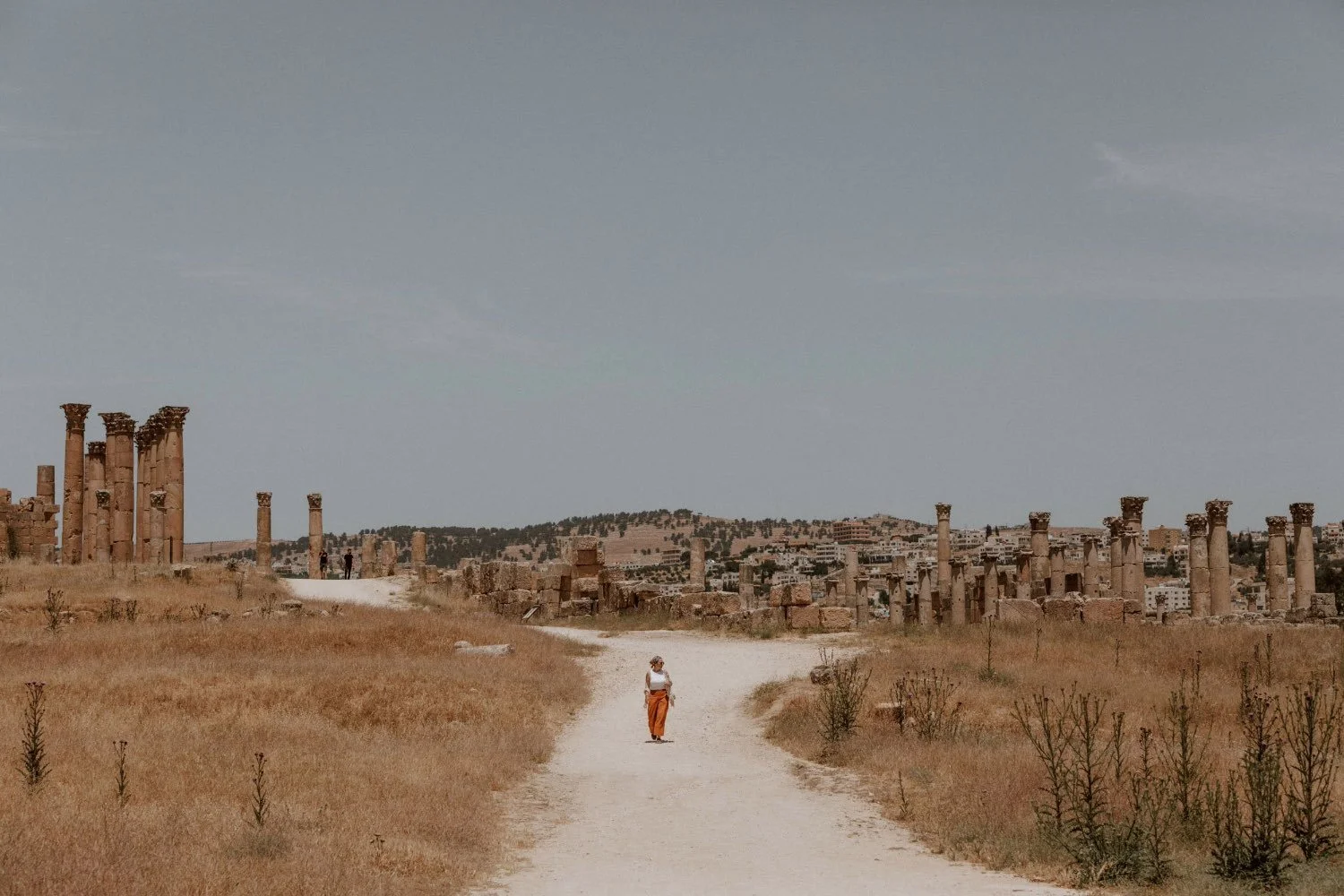
The crowds dissipated, and we were suddenly quite alone; the grandeur of old Jerash – a place sometimes referred to as the ‘Pompeii of the Middle East’ – unveiled itself in the silence.
The land once called Gerasa (Jerash is the Arabised name) has been inhabited for millennia, with evidence of occupation from as early as 7500 BC. However it wasn’t until the Romans arrived in 63 BC that this ancient city atop a hill began to flourish, becoming part of the Roman province of Arabia in 106 AD (this province also included Amman and Petra).
Jerash reached its zenith in the late second and early third century, as road connections between the great cities in the east led to trade and taxation, wealth and expansion (both in population and construction); in 129 AD, Emperor Hadrian – yep, he of the UK wall fame – even sojourned here for an entire year.
Alas, as is often the case in these once great metropoli, Jerash began a slow slip into anonymity in the several centuries that followed, as trade routes that had once been so profitable were eschewed for ships that sailed the sea. Invaded by the Persians in 615 AD and conquered by Muslim forces in 636 AD, it was a devastating earthquake in 749 AD that finally consigned the city to the history books for more than 1000 years.
The Jerash that you will explore in the north of this impressive country was re-discovered by European explorers (including the infamous Burckhardt – read more about him in our Petra guide) at the beginning of the 19th century, and archeological ruins continue to be uncovered and meticulously restored even to this day.
If it weren’t for the more famous Petra and Wadi Rum in the south, we reckon Jerash in the north would attract a lot more buzz about it, with the ruins considered one of the best preserved sites of Roman architecture outside of Italy.
Whether you’re visiting Jerash on a day trip from Amman (which is very likely) or stopping by as part of a longer Jordan road trip, in this guide we’ll cover everything you need to know to plan your trip! Including how to get there, ticket info, the sites you absolutely can’t miss and our advice on where to stay if you’re spending the night.

