

12Views 0Comments

Is he wiring New Delhi, Amman, and Brussels? – Middle East Monitor
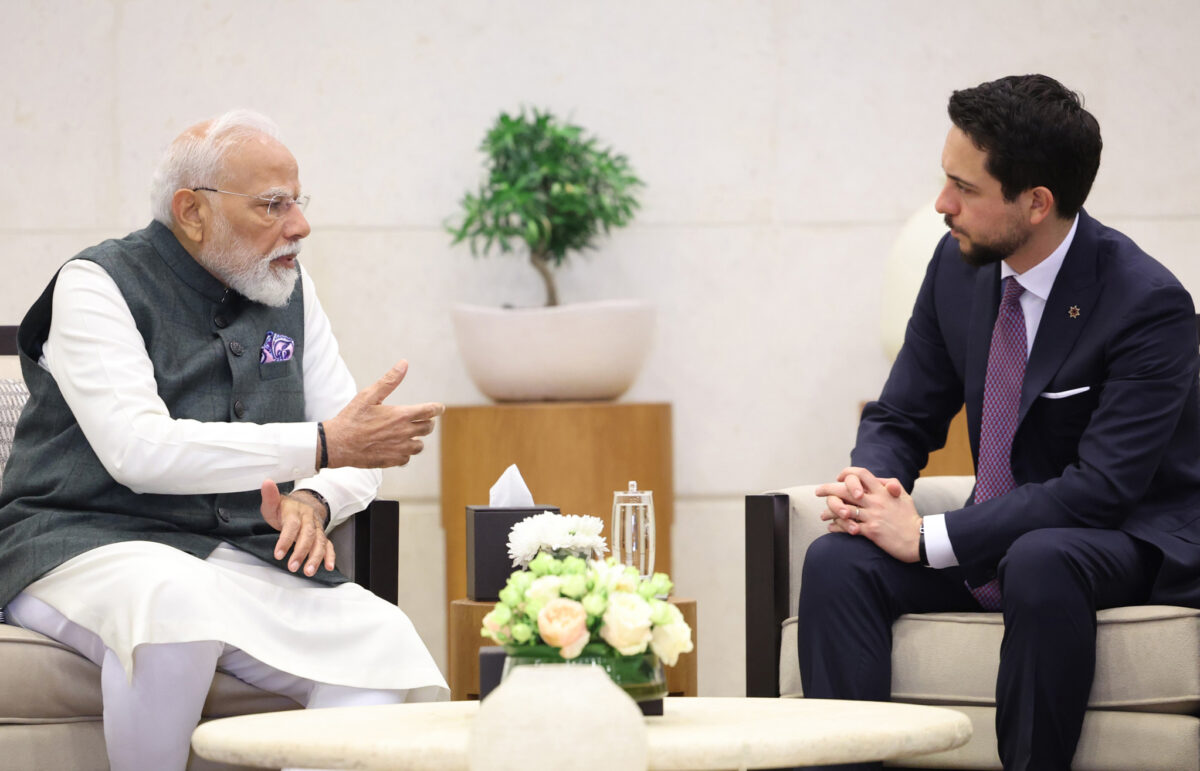
Prime Minister Modi became the first Indian Prime Minister to undertake a full-fledged state visit to the Kingdom of Jordan on 15–16 December 2025, at the invitation of King Abdullah II ibn Al Hussein. The visit coincided with the celebration of the 75th anniversary of bilateral diplomatic relations between the two countries. In 2018, Prime Minister Modi had made a brief transit stop in Jordan while en route to Palestine. During the visit, both leaders conducted a comprehensive review of bilateral ties and discussed regional issues, including Gaza, counterterrorism, and stability in West Asia.
India welcomed Jordan’s willingness to join the International Solar Alliance (ISA), the Coalition for Disaster Resilient Infrastructure (CDRI), and the Global Biofuel Alliance (GBA).
During the visit, the two countries signed five MoUs/agreements:
- MoU on Technical Cooperation in the Field of New and Renewable Energy
- MoU on Cooperation in the Field of Water Resources Management and Development
- Twinning Agreement between Petra and Ellora
- Renewal of the Cultural Exchange Programme for the period 2025–2029
- Letter of Intent on cooperation in sharing successful digital solutions implemented at population scale for digital transformation
The seventy-five-year-old bilateral relationship spans various areas of cooperation, including political, economic, defence, security, culture, and education.
India is Jordan’s third-largest trading partner. Total bilateral trade stands at around USD 2.3 billion, with a new target of USD 5 billion over the next five years. Indian investment in Jordan amounts to approximately USD 1.5 billion in fertilisers, textiles, garments, and manufacturing, providing employment to around 75,000 Jordanians.
Jordan is a key supplier of fertilisers, especially phosphorus and potash, to India. The IFFCO–India Jordan Phosphate Mines Company project and the Indo-Jordan Chemical Company are major joint ventures.
Around 17,500 Indians are working in Jordan, primarily in textiles, construction, and manufacturing.
At the end of the visit, a joint statement was issued. However, the themes highlighted during Prime Minister Modi’s address at the Jordan–India Economic Forum appeared more optimistic and potentially impactful at bilateral, multilateral, and regional levels, if fully implemented.
During his address of the Economic Forum, Prime Minister Modi highlighted the following areas of mutual interest:
- Indian companies can access the markets of the United States, Canada, and other countries through Jordan.
- Trade routes can connect Gujarat to Europe via Petra.
- India’s growth is driven by productivity-oriented governance and innovation-led policies.
- Jordan can become a partner in India’s rapid growth and secure strong returns on investment.
- The world needs trusted and resilient supply chains; together, India and Jordan can meet the demands of the global economy.
- Digital Public Infrastructure and IT are key strengths. Frameworks such as UPI, Aadhaar (Unique Identity Number), and DigiLocker have become global benchmarks. Start-ups in fintech, health-tech, and agri-tech can be developed through a shared ecosystem linking ideas with capital and innovation with scale.
- Healthcare is no longer just a sector; it is a strategic priority. Pharmaceuticals and medical devices are core pillars. India’s generics, vaccines, Ayurveda, and wellness solutions ensure affordable and effective healthcare.
- Agriculture is another priority area. Cooperation in dry farming, precision farming, and micro-irrigation can make a significant difference. Both countries can also work together on cold chains, food parks, storage facilities, and joint ventures in fertilisers.
- Infrastructure and construction are essential for rapid growth. Collaboration can provide both speed and scale, including in railways and next-generation infrastructure in Jordan. Indian companies are capable of and keen to partner in this effort.
- Infrastructure reconstruction needs in Syria present opportunities for collaboration between Indian and Jordanian companies.
- Green growth is a necessity. Clean energy is no longer optional. India is an active investor in solar, wind, green hydrogen, and energy storage, while Jordan has strong potential that can be jointly developed.
- The automobile and mobility sector also holds great potential. India is among the global leaders in affordable EVs, two-wheelers, and CNG mobility solutions, offering wide scope for collaboration.
- Heritage and cultural tourism offer promising opportunities. Film shooting, joint film festivals, and related initiatives can be encouraged.
- Geography is Jordan’s strength; India brings skill and scale. Joint cooperation can multiply the benefits.
Analysis of the visit
At first glance, the visit to Jordan appears to be a routine effort by the Indian Prime Minister to strengthen bilateral relations with West Asian countries. It formed part of India’s Act West policy, initiated during the tenure of Prime Minister Manmohan Singh in 2005, on the lines of the Look/Act East policy. Since assuming office in 2014, Prime Minister Modi has undertaken several visits to West Asia, including seven visits to the UAE, three to Saudi Arabia, and two each to Qatar and Oman.
Some experts view that Jordan offers limited strategic leverage, while others do not view the visit in isolation, rather as an attempt to achieve broader economic, geopolitical, and strategic objectives.
Amman is considered as the kitchen of the Arab world’s politics; factory of arms manufacturing, supplied to Libya, Sudan, Sahil and the rebel groups in African countries, including Nigeria. Jordan is a weak, your majesty man of the US.
First, as Gulf countries are losing their collective consensus, bilateral engagements have become increasingly important for sustaining relations with the region. India is not alone in this approach. Major global powers that depend on the Gulf for economic, energy, remittance, and strategic interests—such as China, Japan, Britain, France, Germany, and South Korea, along with traditional allies like the United States and Russia—are also deepening bilateral partnerships.
Second, GCC countries are increasingly adopting independent foreign policy stances rather than operating as a single monolithic bloc. Countries such as the UAE, Oman, Jordan, Saudi Arabia, Qatar, and Kuwait are diversifying their external relations, and some—such as the UAE, Jordan, and Oman—have signed Free Trade Agreements. This trend challenges the unity and centrality of the GCC as a bloc.
At the same time, these countries offer opportunities for emerging economies to access regional markets and, indirectly, markets of countries with which they have FTAs. For instance, Jordan and Oman have FTAs with the United States. Strong trade and investment ties with these countries can facilitate India’s entry into the US market. India has already signed FTAs with the UAE and Oman and is negotiating with Israel and Saudi Arabia.
Third, the growing Chinese presence in West Asia has pushed India to deepen bilateral ties in the region. As part of this hedging strategy, Prime Minister Modi has visited almost all major West Asian countries, including GCC members, Iran, Palestine, Israel, and Egypt.
Fourth, the India–Middle East–Europe Economic Corridor (IMEC) factor is significant. Jordan and Greece are crucial links in completing the multimodal IMEC logistics network. Through PM Modi is trying to connect three continents, South Asia, West Asia and Europe. It is important for India for two reasons: first, to develop an alternative transit corridor bypassing the Red Sea route, through which more than USD 200 billion of Indian trade passes but has shown its vulnerabilities; and second, to counter China’s Belt and Road Initiative. Indian investment in Jordan, particularly in IMEC-related infrastructure, can play a key role in operationalising the corridor.
Fifth, Prime Minister Modi’s engagement in West Asia is also seen as an attempt to create a strategic triangle involving Oman on the eastern edge of the Arabian Peninsula, Jordan at the crossroads of West Asia, and Ethiopia in the Horn of Africa. This is viewed as a counter to the Turkey–Pakistan axis, particularly in the context of Turkey’s support for Pakistan during Operation Sindoor (recent India- Pakistan War).
Finally, India is seeking to counter Pakistan’s influence in West Asia through its growing economic, technological, and strategic capabilities. This includes deepening economic, technological, and security cooperation to promote regional peace and stability. India and Jordan share common views on counterterrorism and have cooperated closely on this front. King Abdullah II was among the first leaders to call Prime Minister Modi following the Pahalgam incident.
The views expressed in this article belong to the author and do not necessarily reflect the editorial policy of Middle East Monitor.

