

27Views 0Comments

Off the beaten path in Sichuan and Qinghai

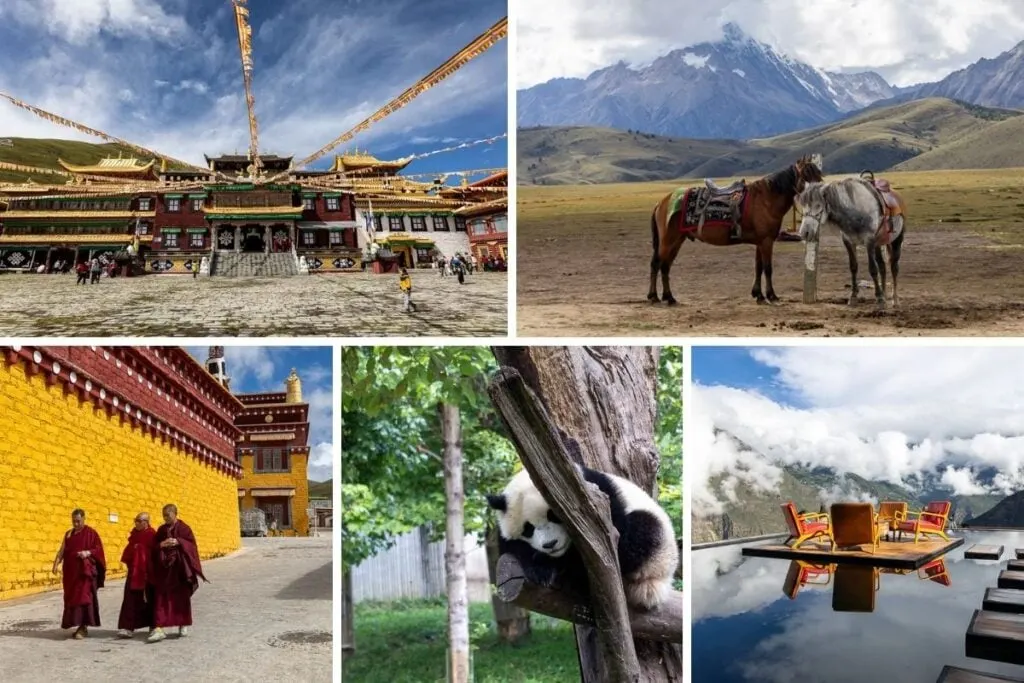
I recently embarked on an incredible adventure, a two-week road trip on the Tibetan Plateau. Our China itinerary with Eastogo Travel was their incredible ‘Whispering Winds of the Tibetan Plateau’ signature journey which uncovers the Western China part of the plateau bordering Tibet.
We started in Chengdu before heading off the beaten track through Western Sichuan to the Tibetan Plateau. Then, travelling northeast, we finished our trip in the city of Xining in the province of Qinghai.
Our journey offered a chance to make some unforgettable memories as we explored a lesser-known side of Western China. We immersed ourselves in Tibetan culture, visiting monasteries and temples, meditated with monks and hiked panoramic valleys and mountains. We shared food with nomads on vast grasslands, rode horses and encountered wildlife under the immense skies of Qinhai.
We spun prayer wheels and placed mani stones as Buddhist mantras and incense floated through the air. We encountered Tibetan culture, faith, spirituality, curiosity and kindness. And a million yaks!
Before I introduce you to our China itinerary there are a few things to know about the Tibetan Plateau which will help you understand our journey into Tibetan culture better.
Disclaimer: This post is in collaboration with Eastogo Travel. As always, the opinions, thoughts and experiences below are entirely my own. This post may contain affiliate links, which means that we may earn a small commission for qualifying purchases. More info: disclosure.
A few facts about the Tibetan Plateau
The Tibetan Plateau is the world’s largest plateau, known as ‘the roof of the world’.
It covers an area of about 2.5 million square kilometres (970,000 square miles) and extends into large parts of China as well as Pakistan, Nepal, Bhutan, northern India, Afghanistan, Tajikistan and Kyrgyzstan.
Elevation ranges from 3,100 metres (10,171 ft) in the low-lying cities to the highest points on earth like Mount Everest at 8,848 metres (20,000 ft). The average elevation of the plateau is 4,500 metres (14,800 ft).
Exploring Tibetan Culture
Foreigners need a permit to visit Tibet aka the Tibetan Autonomous Region (TAR) and can only enter if travelling with a local agency. It’s a complicated process.
For this reason, we didn’t cross into Tibet, although we did travel within a stone’s throw of the border. We experienced a wealth of authentic Tibetan culture without the complications of actually entering the TAR.
There are many Tibetan autonomous prefectures in the adjacent provinces of Western Sichuan and in Qinhai, Gansu and Yunnan provinces. These prefectures are home to populations of ethnic Tibetans living the Tibetan way of life.
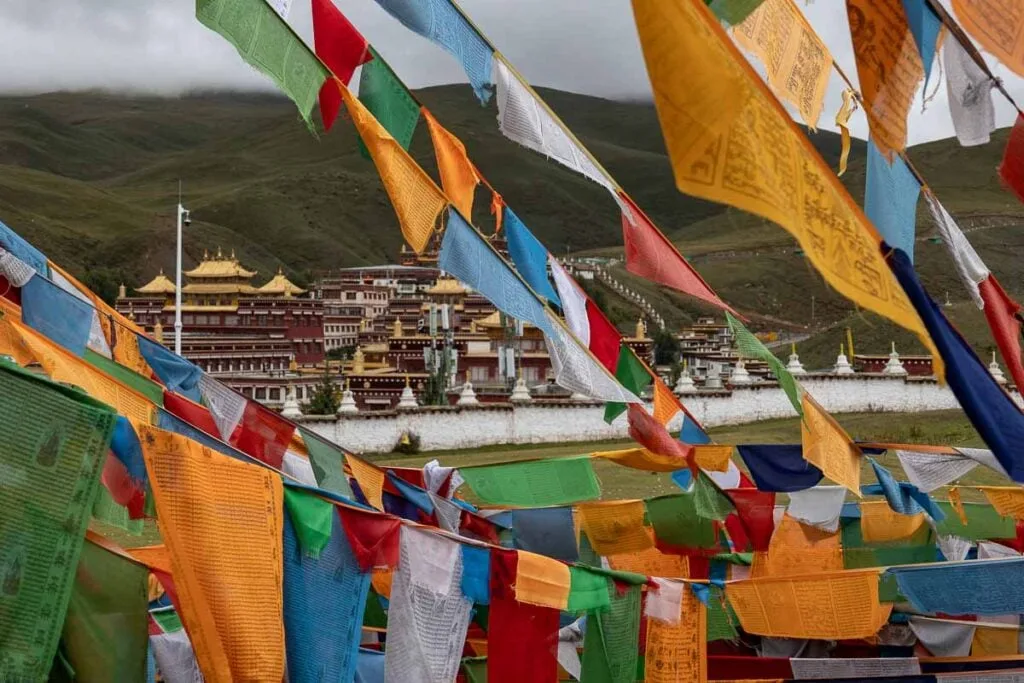
They offer an authentic Tibetan experience which is just as compelling as stepping into Tibet itself. We visited Garze and Yushu prefectures on our Tibetan Plateau road trip, starting in Chengdu and ending in the city of Xining.
Travelling with Eastogo Travel
Exploring the Tibetan regions of Sichuan and Qinghai is one of the most incredible journeys you can make in China. But it has its challenges. Language barriers, remote mountain passes, and cultural differences mean it’s a tricky trip to tackle alone.
We travelled with Eastogo Travel, for our two weeks in China. They’re a small, specialist agency that creates private, tailor-made tours across Western China and the Tibetan plateau. They made our entire road trip smoother, deeper and far more enriching than anything we could have organised ourselves. These tours are excellent for adventurous first time visitors.
Eastogo was founded by Z, an intrepid traveller with a lifelong passion for Tibet who’s hitchhiked across China three times. His knowledge of the region runs deep, and he’s built a team who share the same enthusiasm and respect for Tibetan culture. Travelling with someone who not only understands the landscape but genuinely cares about it adds a completely different dimension to the journey. Z was a brilliant travel guide.
Stays that surprise you in the best possible way
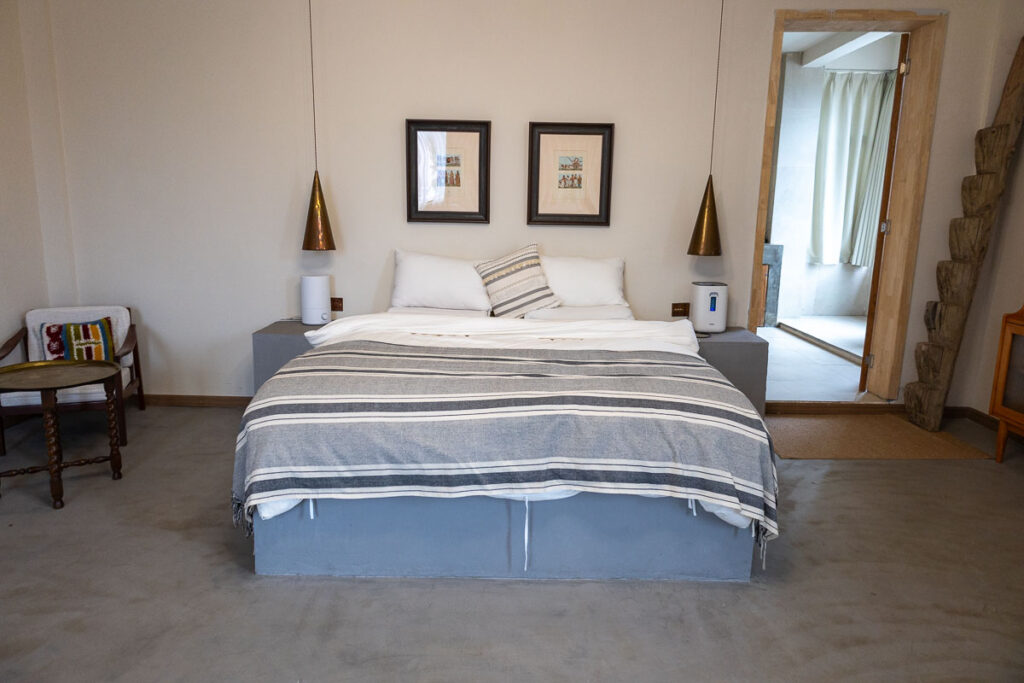
I’ll be honest, when we ventured into more remote areas, I wasn’t expecting much in the way of creature comforts but Eastogo had us covered. We enjoyed inviting guesthouses and stylish boutique stays. Some high altitude stays even came equipped with oxygen diffusers. A detail that made such a difference to our sleep and overall comfort during the trip.
Authentic Experiences you can’t access alone
What really set this trip apart were the unusual experiences that aren’t available to independent travellers. Thanks to Eastogo’s connections within Tibetan communities, we were welcomed into places and experienced moments that felt incredibly special;
• meditating in a monastery garden under the guidance of a monk
• spending a day with a nomadic herding family on the grasslands
• carving our own mani prayer stones
• and that unforgettable moment of spotting Tibetan brown bears in the wild
These weren’t staged or contrived but genuine encounters that will stay with me always.
Smooth, Stress-Free Travel with Back-Up When It Counts
As someone who normally organises my own travels, it was good to simply relax and let the team take over. Each evening we received detailed plans for the next day.
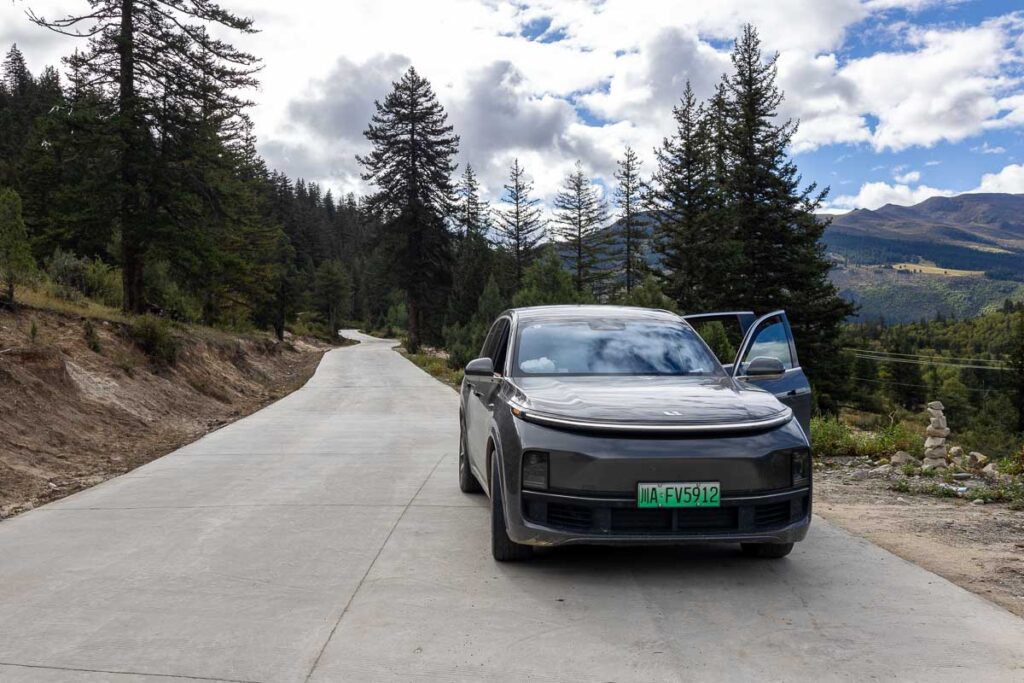
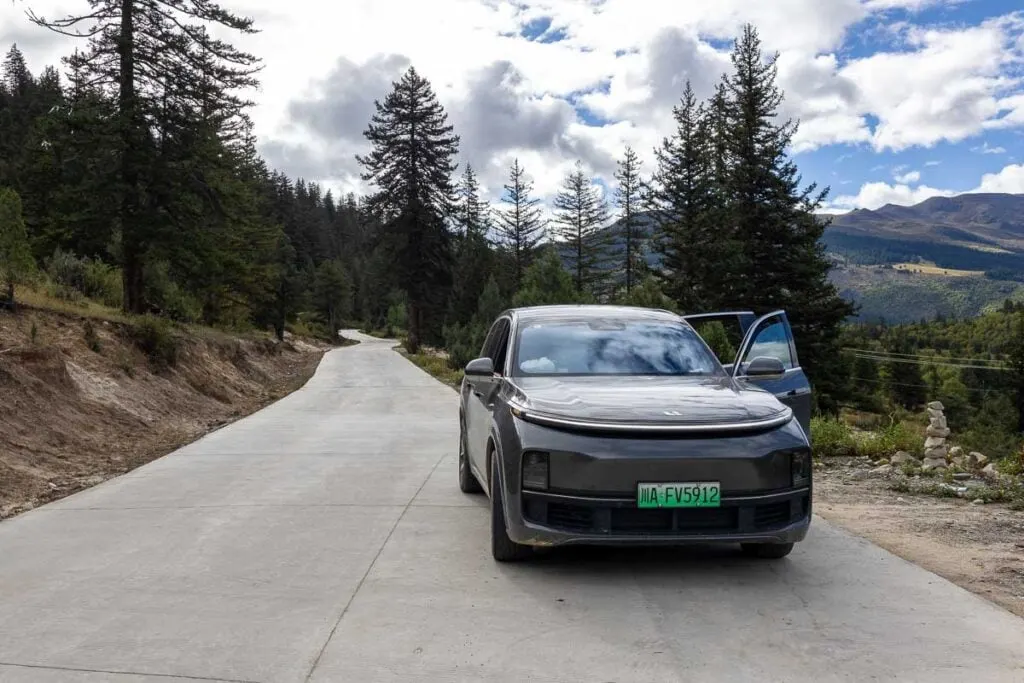
Our vehicle was well-equipped for high-altitude, challenging roads, some of which would be completely inaccessible in a standard minibus.
Altitude is unpredictable, and this is where travelling with a specialist agency really proved its worth. When one of our group needed to descend quickly, Eastogo rearranged everything for her quickly; medical support, accommodation, transport and a whole new China itinerary at a lower altitude.
Flexible, Thoughtfully Designed Itineraries
Our journey was a two-week, extended version of Eastogo’s signature route, “The Whispering Winds of the Tibetan Plateau.” They also offer a shorter China tours of a one-week version, but stretching it over a fortnight allowed us to venture into far-flung corners and enjoy a more immersive experience.
If you prefer company on your travels or want to keep costs down, Eastogo also offers small group departures for this route. Otherwise, you can opt for a fully private, tailor-made trip designed entirely around your interests.
If you’re planning a road trip through Tibetan Sichuan or Qinghai, I can wholeheartedly recommend Eastogo Travel. My western China experience left me with so many meaningful memories, a love for China and a longing to return.
I’m breaking our China travel itinerary down into two parts to keep it readable for you.
In this post, I’ll cover the first week of our itinerary, in Sichuan and then share the second week from Baiyu to Qinghai province separately. Otherwise it’s a lot all in one go.
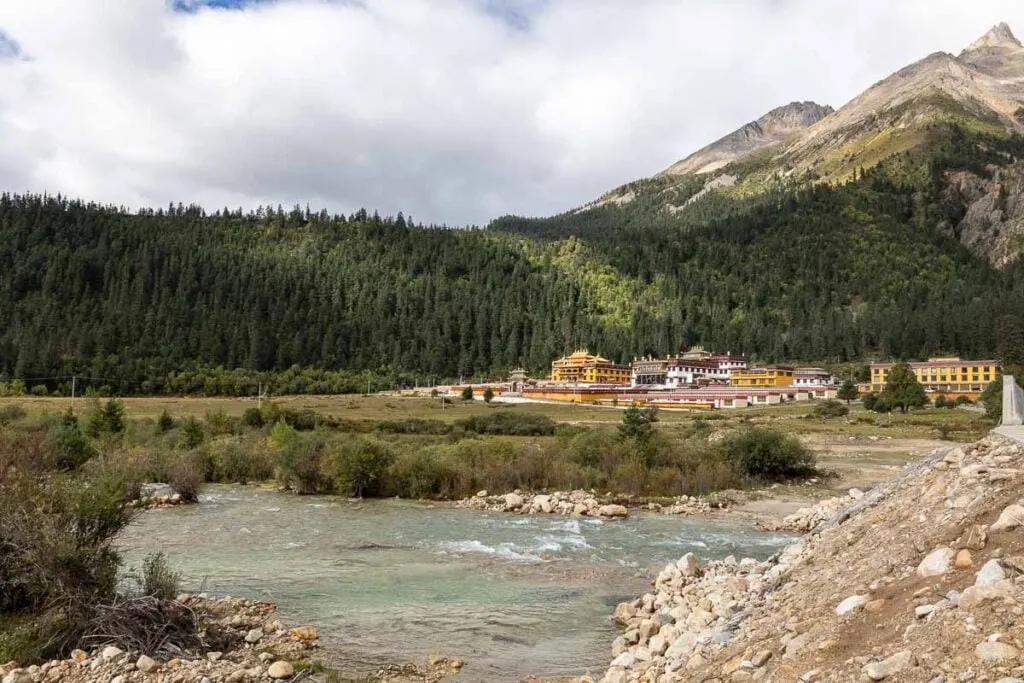
A brief outline of our 2-week China itinerary
Week one: Sichuan – Ganzi/Garze Prefecture
Day 1 Arrival in Chengdu
Day 2 Zhonglu Tibetan Village → Tagong Grassland
Day 3 Tagong Grassland
Day 4 Tagong → Litang → Changqingchunkeer Monastery → Letong Ancient Town → Qianhu Tibetan Village
Day 5 Litang → Xiazetong Village → Eye of Genyen Mountain → Zeba Village
Day 6 Zeba Village → New Lenggu Monastery → Old Lenggu Monastery → Batang
Day 7 Batang → Baiyu Monastery → Katok Monastery
Week Two: Sichuan to Qinghai – Yushu Prefecture
Day 8 Katok Monastery → Zhuqing Monastery → Dege County (Sichuan)
Qinghai – Yushu Prefecture
Day 9 Dege Sichuan → Yushu
Day 10 Yushu: Jiegu Monastery → Mani Stones → Jiana Mani Stone City
Day 11 Yushu → Maduo
Qinghai – Xining
Day 12 Maduo → Ta’er Monastery → Xining
Day 13 Departure from Xining
Week One China Itinerary – travelling off the beaten path in Sichuan
I flew into China from London with China Southern airlines and arrived at Chengdu Tianfu airport in the evening, arriving at my hotel around 9pm. After a good night’s sleep, I was ready to meet the rest of the group and hit the road the next morning.
Accommodation in Chengdu
I spent my night in Chengdu at the Luxianlun Hotel. This luxe, contemporary hotel is a 45-minute drive from Tianfu airport and a metro-ride away from the city.
A quick note re booking accommodation and transfers in China. Trip is recommended over Booking.com because a) more options and b) Trip is generally the cheaper option. I used it for hotels and transfers and am happy to recommend it. I’ve also used it for European flights since I got home, and new users get some decent discounts too.
Day 1: Chengdu to Zhonglu Tibetan Village via Wolong Shenshuping Panda Base
After an excellent breakfast I met Z, our guide and also the owner of Eastogo Travel. With two other travel bloggers, and our driver, we set off on the first leg of our Tibetan Plateau road trip.

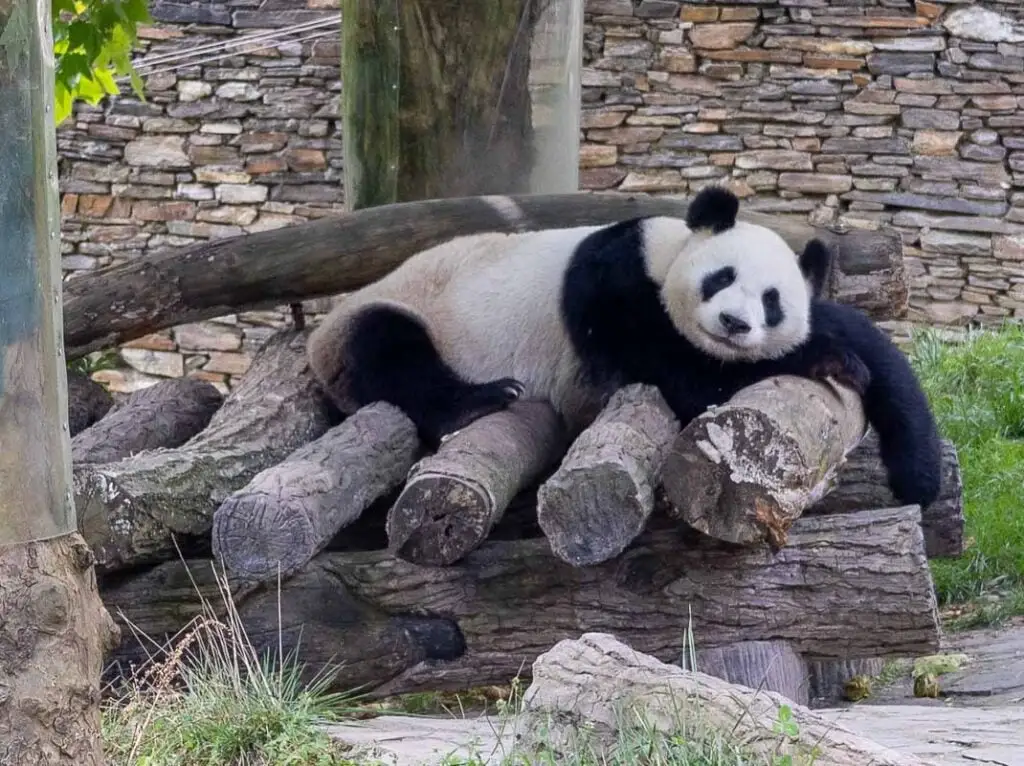
Pandas and Hot Pot
Our first stop was Wolong Shenshuping Panda Base. I was really excited to see pandas for the first time, and they didn’t disappoint. They’re very good at climbing trees, rolling head over heels down slopes, lazing around and generally entertaining any onlookers. And they actually look like they’re smiling.
On a more serious note, Pandas are on the endangered list and the Panda breeding centres in China are helping with their conservation.
Pandas have a very short breeding season and are very picky when it comes to choosing a mate, so they don’t produce enough cubs to be sustainable. Loss of habitat is also a factor.
There are a few Panda bases in the area but this one is a little further out so it’s not as busy as those closer to Chengdu city. If you’re heading into Western Sichuan, it’s worth stopping here enroute if you want to see Pandas in a quieter environment.
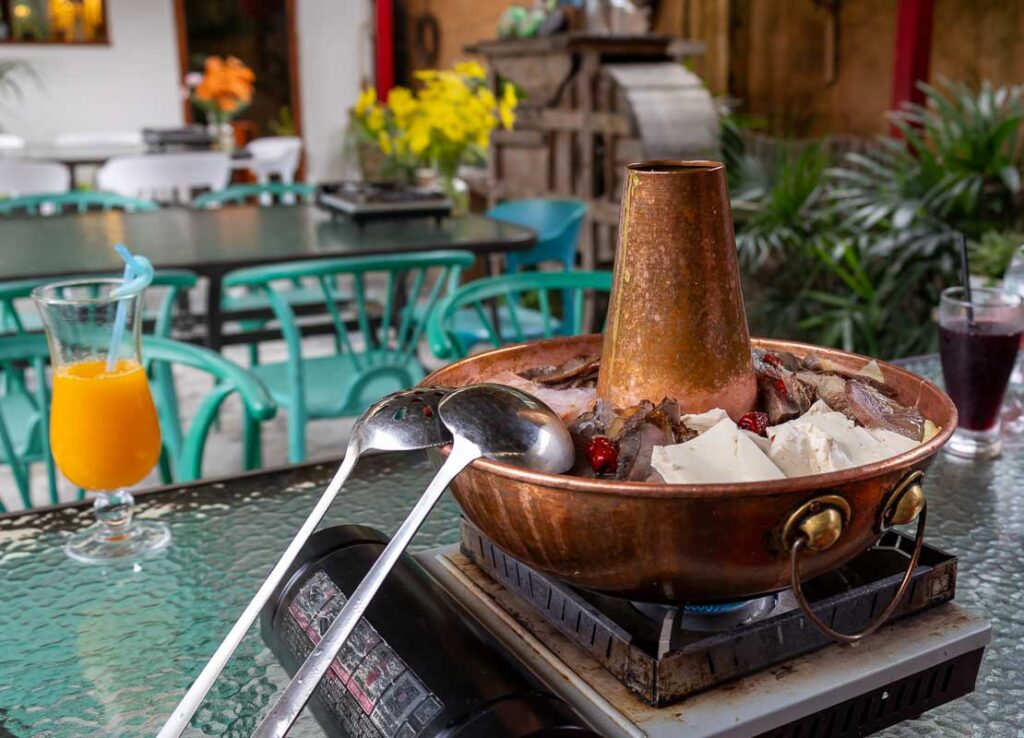
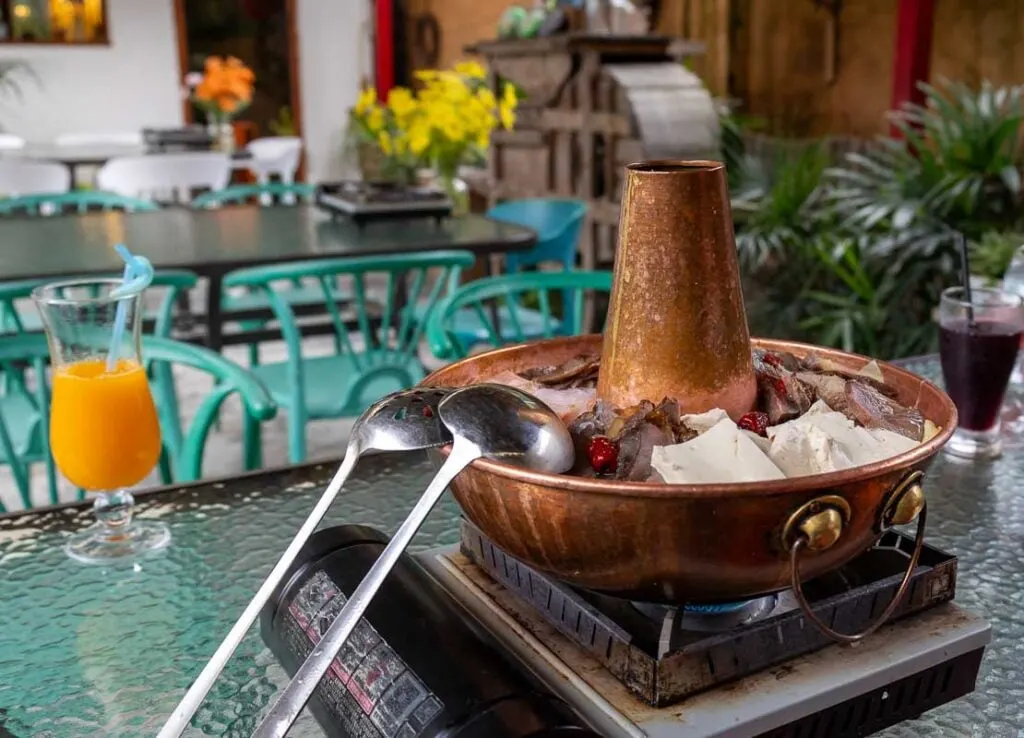
For lunch we stopped at a restaurant a short walk away. Hot Pot is a Sichuan institution and involves a communal simmering pot of broth on an open flame, various ingredients to cook in it and a variety of spicy dipping sauces like chilli, garlic and ginger.
My first Hot Pot came with yak meat, tofu, mushrooms, spam(!) and noodles and it was very good and the first of many hot pots which we enjoyed throughout our trip.
After lunch we set off for Zhonglu Tibetan village stopping for the views at Mount Siguniang en route. Sadly, it was hiding shyly behind low cloud but we tried some tasty yak milk snacks and cheese from the street stalls nearby.
Zhonglu Tibetan Village
After zigging and zagging our way up a narrow mountain road, passing colourful Tibetan style houses and stone watchtowers, we arrived in Zhonglu just before dusk.
We were welcomed at our guest house with our first traditional ‘khata’, a white ceremonial scarf which is placed into your hands and worn around the neck. I collected three or four during our trip!
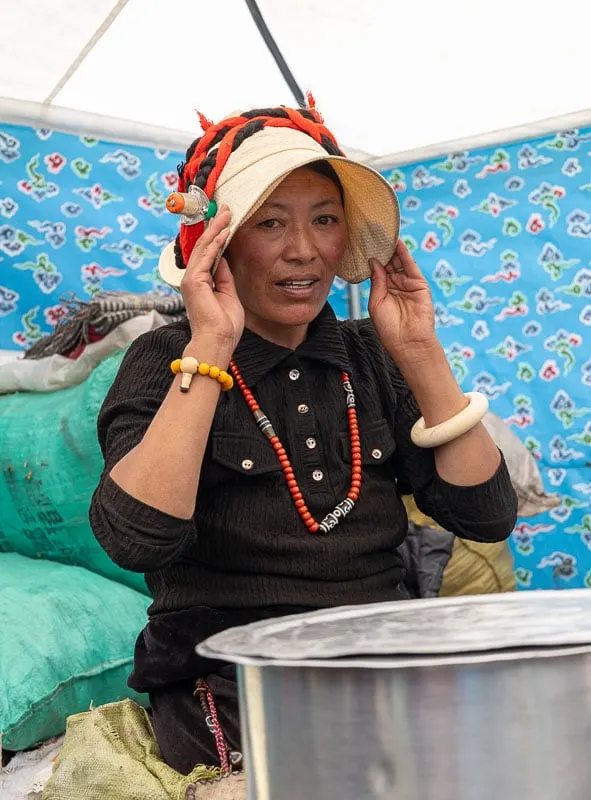
After a hot pot dinner, we were able to try on the traditional dress of the local Gyarong Tibetan people and dance around a welcome fire. The clothing is very colourful and the headwear quite heavy. I can see how it would’ve kept Tibetan people warm during cold winters.
Day 2: Zhonglu Tibetan Village and drive to Tagong Grassland
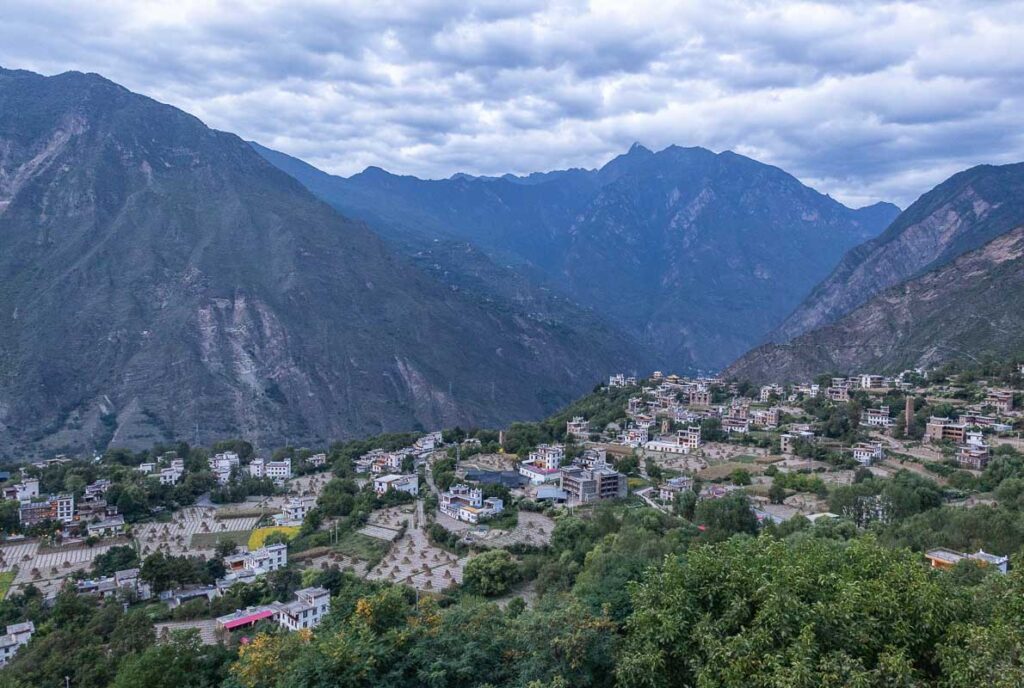
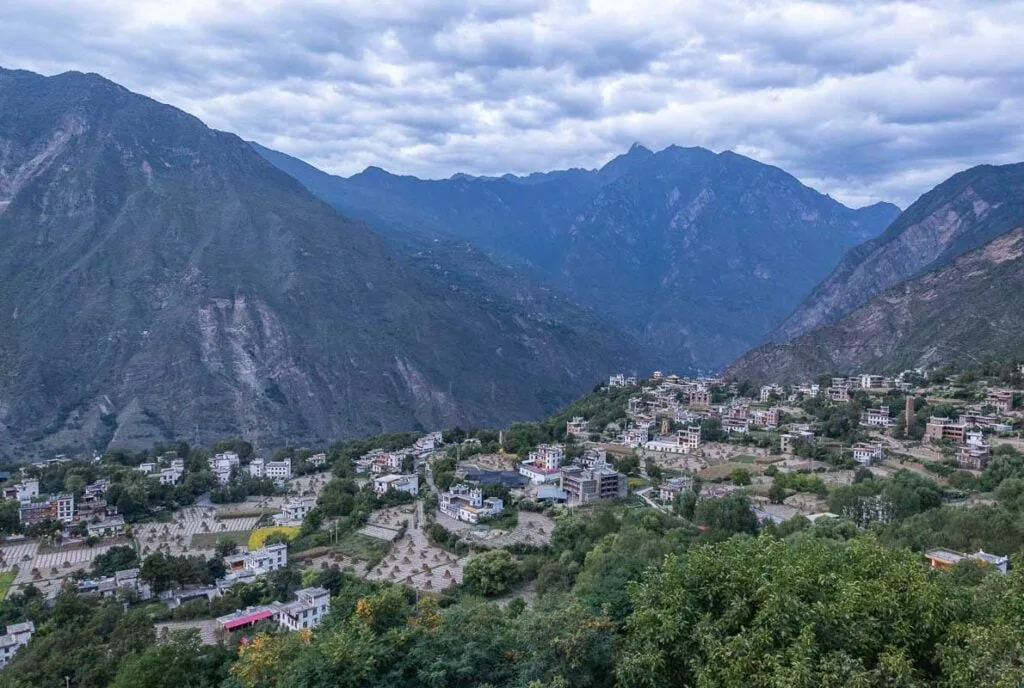
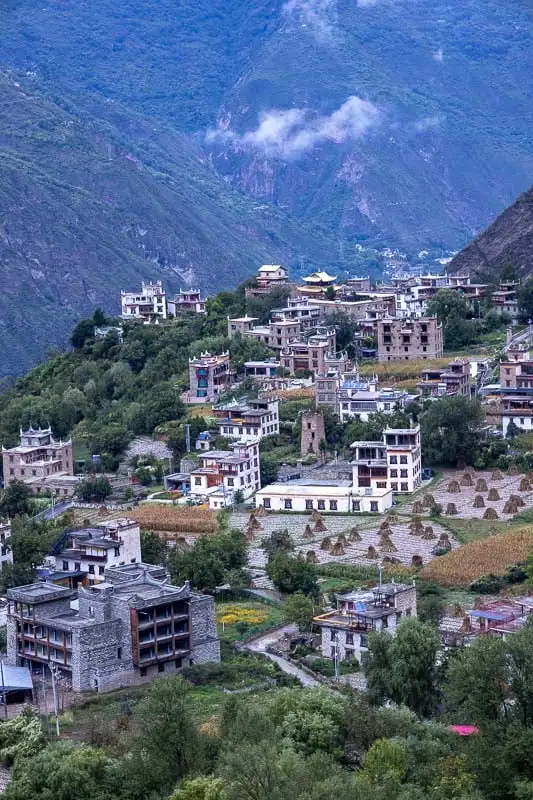
After breakfast it was time to explore more of Zhonglu. We made our way on foot to an observation deck overlooking Zhonglu and Mordo, the mountain on the other side of the gorge, one of the four great holy mountains of Tibet. The views are breath-taking. There are Han Dynasty stone coffin burial complexes in the area which we didn’t visit.

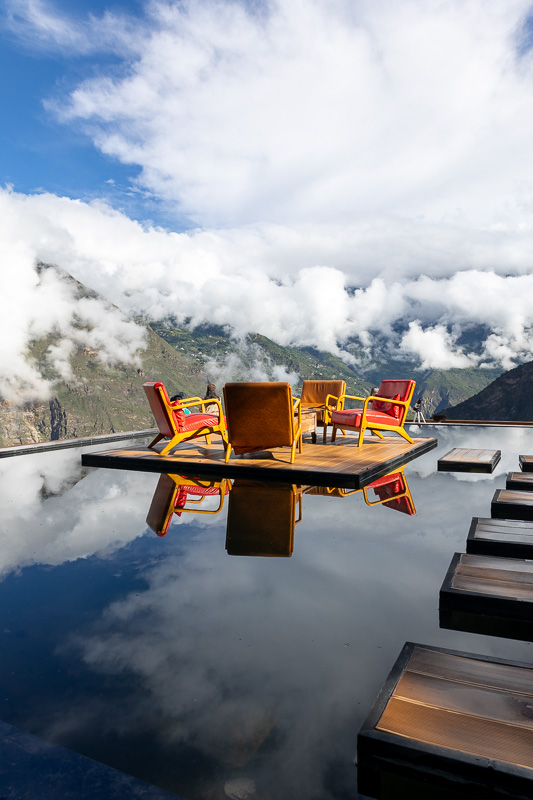
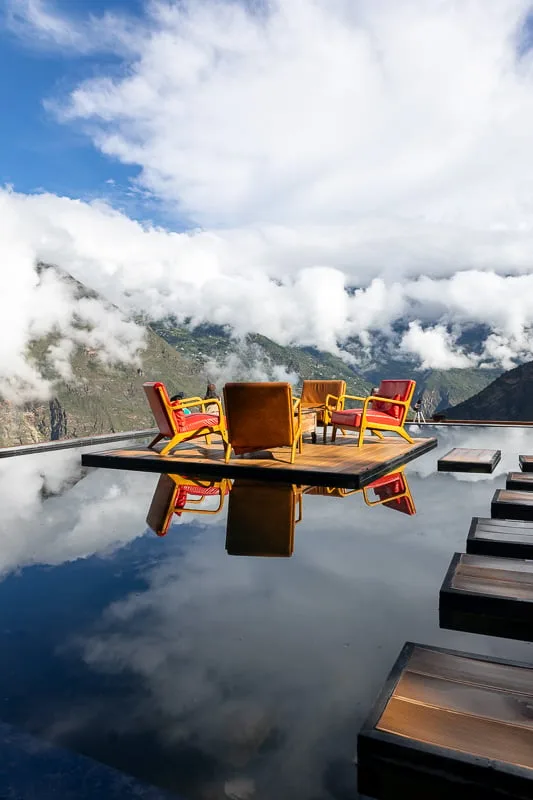
On our way back down the mountain we stopped at another boutique guesthouse to enjoy tea at the most beautiful spot. I could’ve stayed all day, but it was time to continue our journey, the Grasslands were calling.
Accommodation in Zhonglu
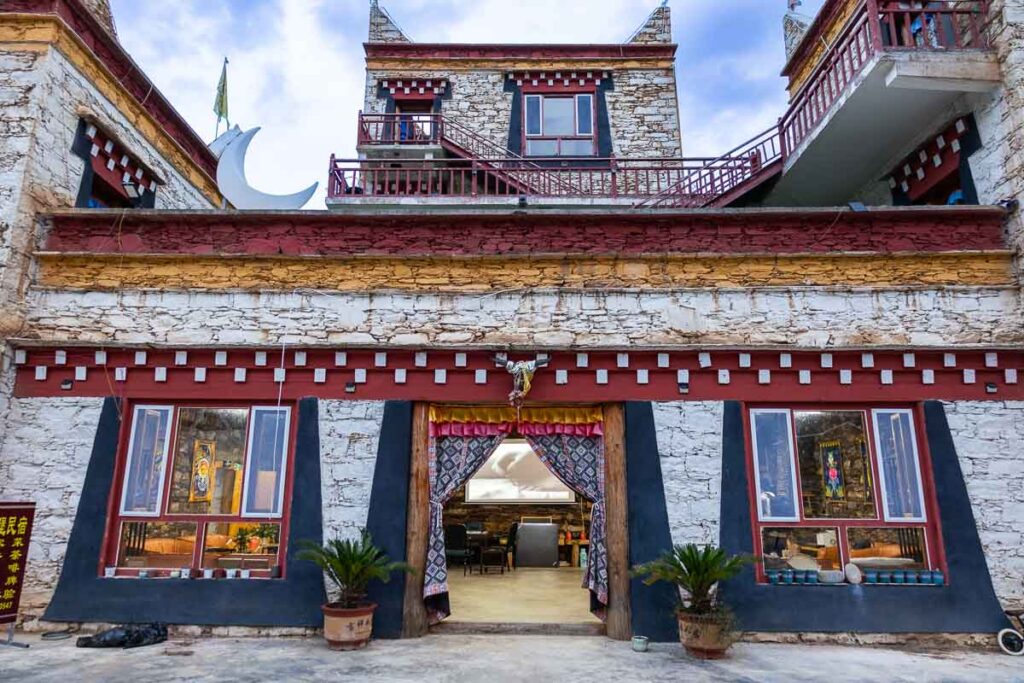
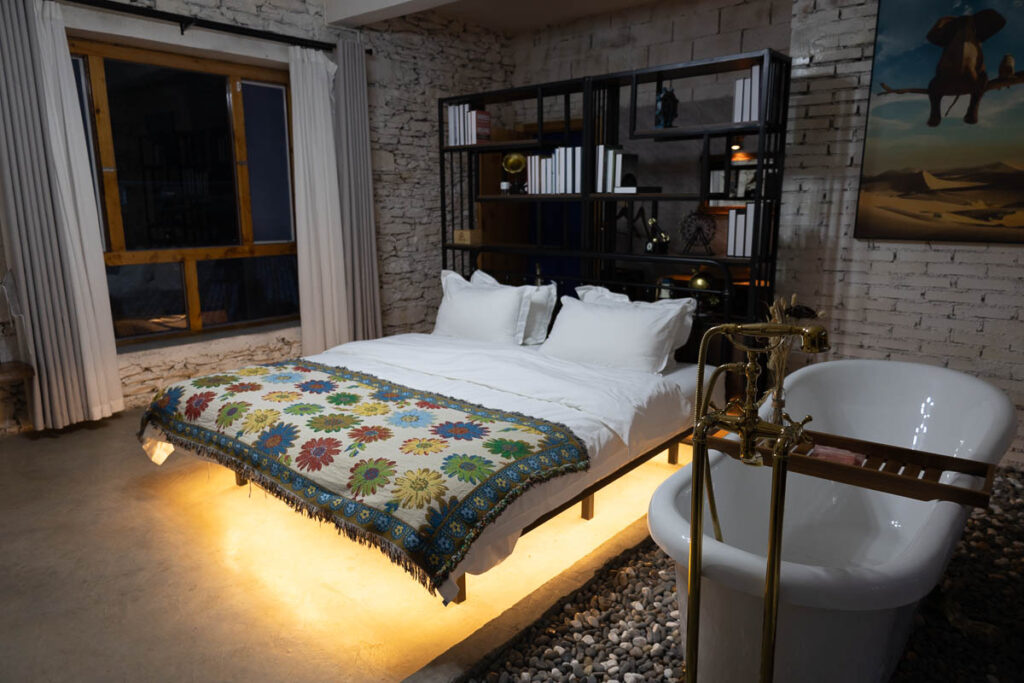
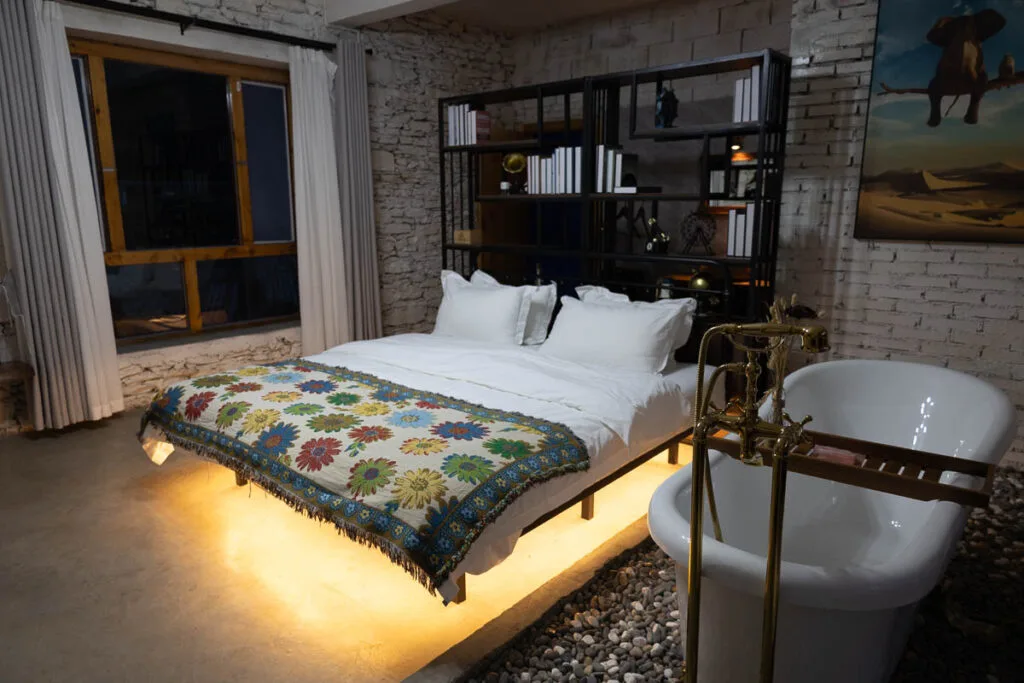
We stayed one night in the excellent traditional Tibetan boutique Gonggubao Guesthouse, Zhonglu. My spacious room was at the top of the building in a tower with triple aspect windows and a free-standing bathtub (with stunning views) as well as a shower. I slept very soundly and would highly recommend a stay here.
The town of Tagong
Heading down through lush, mountainous scenery we made our way to the valley floor for the three-hour drive to Tagong, much of it alongside the Donggu river. Tagong, the next stop on our China itinerary, is a small monastery town rich with Buddhist traditions and an entirely different, but equally beautiful, landscape. It sits at an altitude of 3,700 metres. We were slowly climbing higher and gradually acclimatising to the increasing altitude.
Tangong lies within grasslands, a vast area of scenic meadowland known for Tibetan culture and spiritual significance. The grasslands are home to three monasteries; Tagong, Muya and Ani Gompa nunnery.
We arrive at lunchtime and head for a small eatery in the town where I order beef noodles in a spicy broth. Luckily, I’m a big fan of spicy food – it was hot!
A Puja at Tagong Monastery
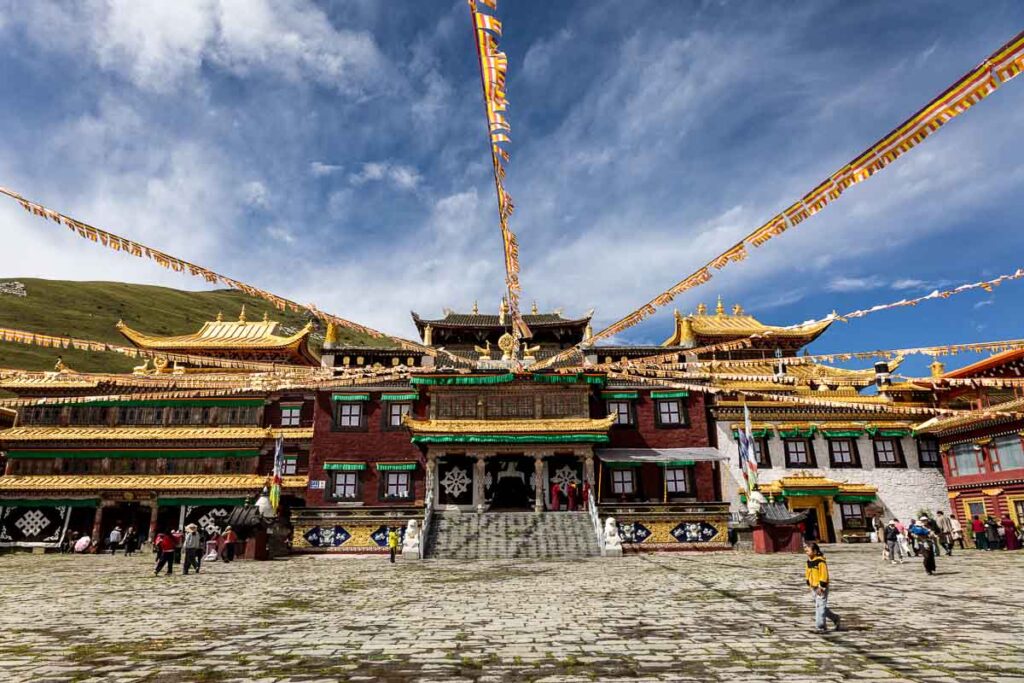
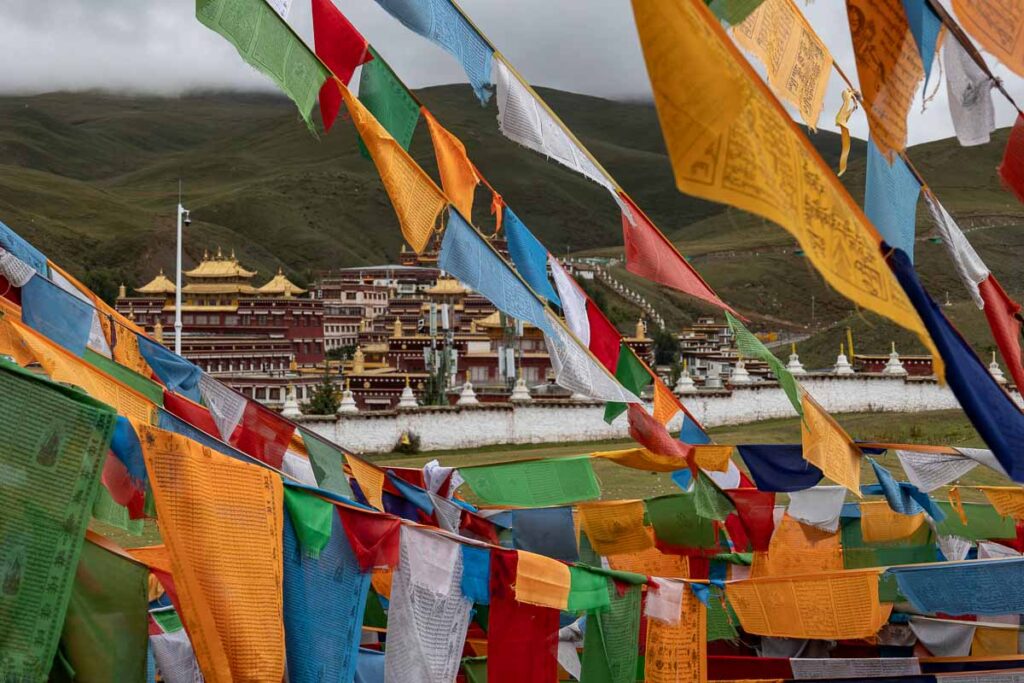
After lunch we crossed the road, passing some prayers wheels, to Tagong (Lhagang) Monastery which is said to be around 1400 years old. There’s excitement in the air and festoons of flags flutter in the breeze. A Puja is taking place.
A gathering of the monks and the faithful will make offerings to the Buddhas and there’s a queue of local people gathering in the courtyard. You don’t get many foreigners in this part of China so they’re curious to see us and glance over with shy smiles.
Because it’s a festival day we’ve been given special permission to use our cameras in the monastery during the traditional Buddhist ceremony. This is usually forbidden so we’re very privileged and it’s an incredible experience which engages all the senses.
We walk around the colourful monastery in a clockwise direction, a practice known as pradakshina, a symbol of reverence and devotion which follows the path of the sun.
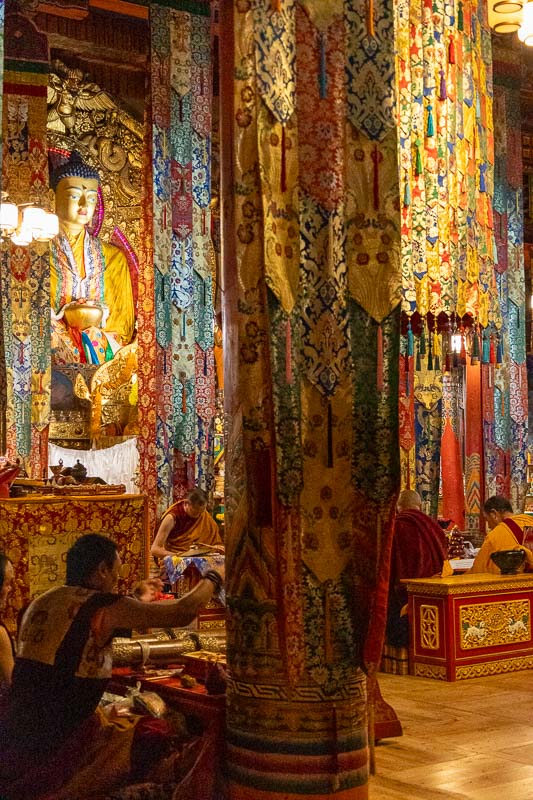
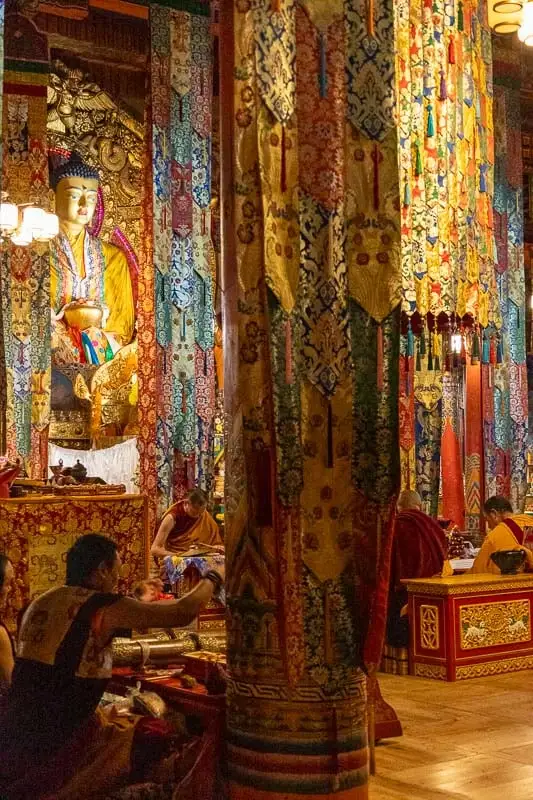
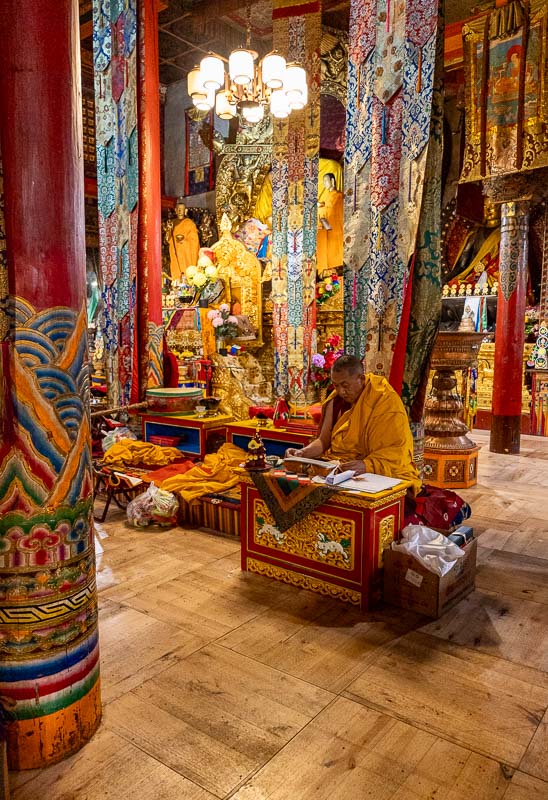
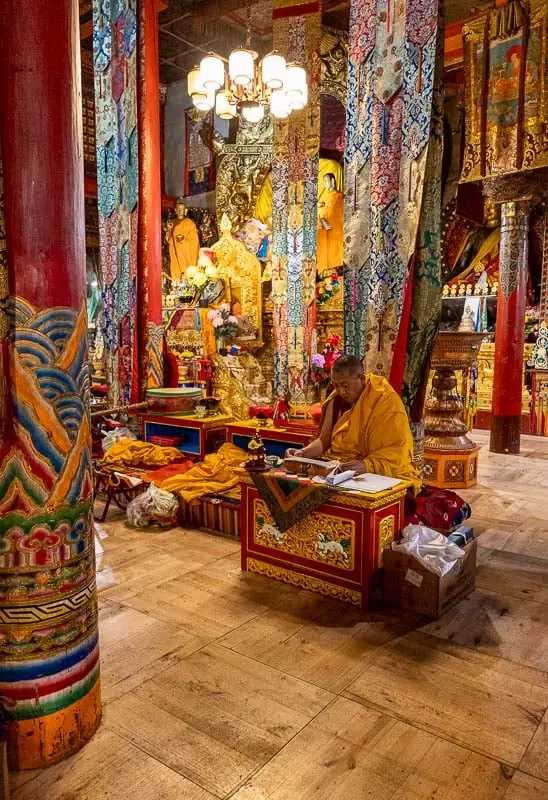
The sound of chanting, gongs, bells, cymbals and dungchen ( 2-3 metre long horns) reverberate around the temple, filling my head with the discordant cacophony. The aroma of incense and yak butter candles hang in the air. It’s like nothing I’ve ever experienced before.
Afterwards we queue up with the local Tibetan people outside and receive a bag of goodies and some tsampa from the monks. China makes some very tasty snacks, which we demolished during the remainder of our road trip.
Muya Monastery and Yala Snow Mountain
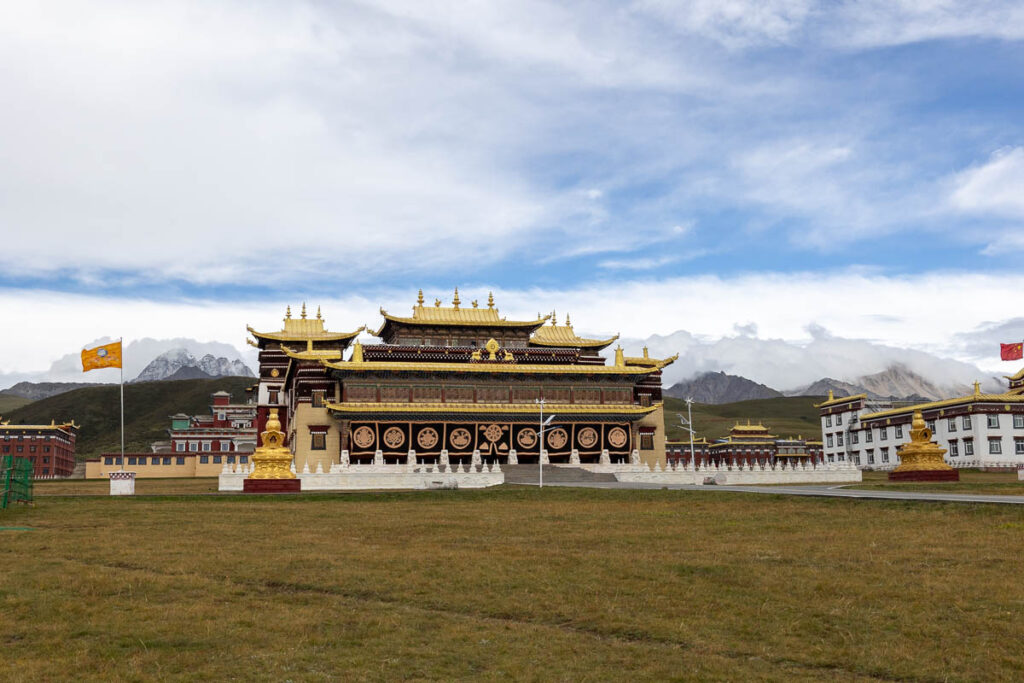
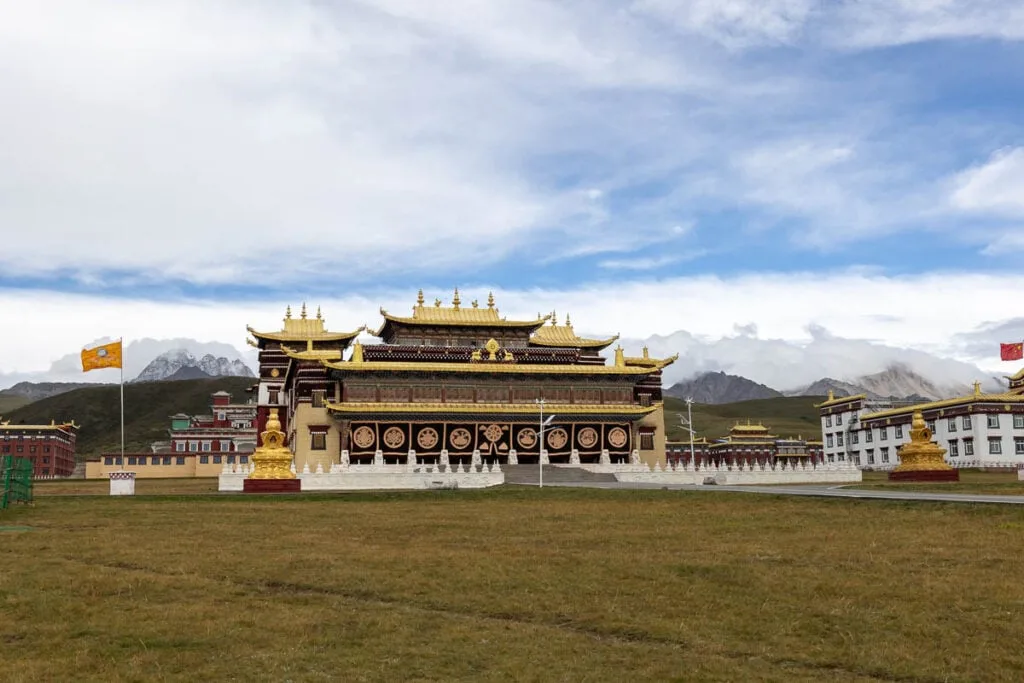
A 20-minute drive away from Tagong town is the sacred Muya Monastery which was established in 1272. The current golden-roofed monastery complex sits at 3900 metres in the grasslands with the imposing Yala Snow Mountain as a backdrop. Spoiler – there was no snow when we were there!
The prayer hall at Muya is huge with brightly painted pillars, chandeliers and colourful carpeted benches where the monks sit to pray, learn and debate. A row of giant Buddhas seated on ornate platforms overlook the hall.
Muya is an important learning centre for monks and lamas in the region and is known for rescuing wild animals. I loved seeing deer roaming the grounds and they were clearly used to humans and didn’t shy away.
Chanting at Ani Gompa Nunnery
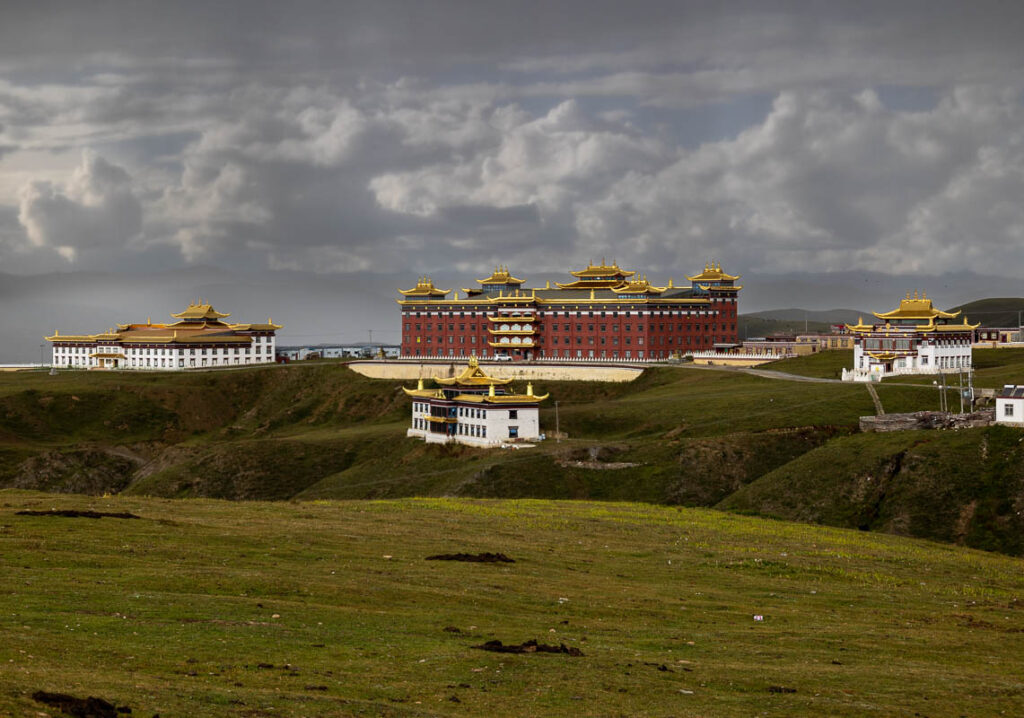
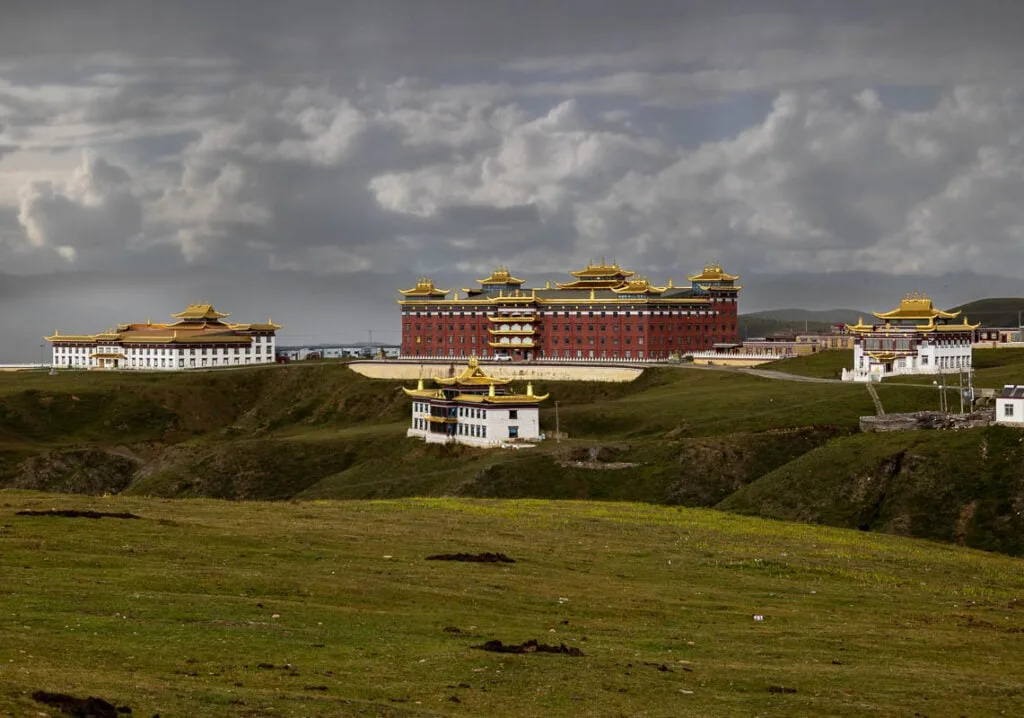
Close to Muya is Ani Gompa monastery for women, where we stopped briefly to listen to the chanting scriptures. The gentle chanting of the nuns accompanied by tiny Tingsha cymbals was mesmerising and a total contrast to that of the monks.
A Guided Mediation in the stupa garden
Heading back to Tagong in the rain we were treated to the sight of the most perfect double rainbow. And the sun came out just in time for us to sit outside in the stupa garden for a guided meditation with a monk. Surrounded by 108 stupas, while our guide translated the monk’s words, just as the sun was setting, was a surreal moment.
Accommodation in Tagong
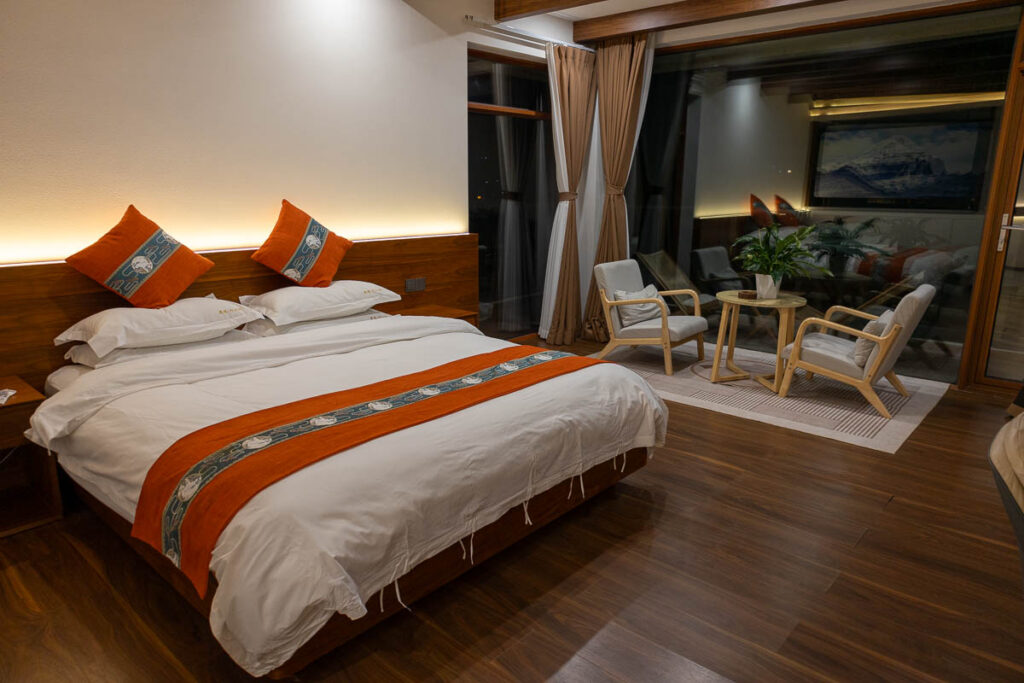
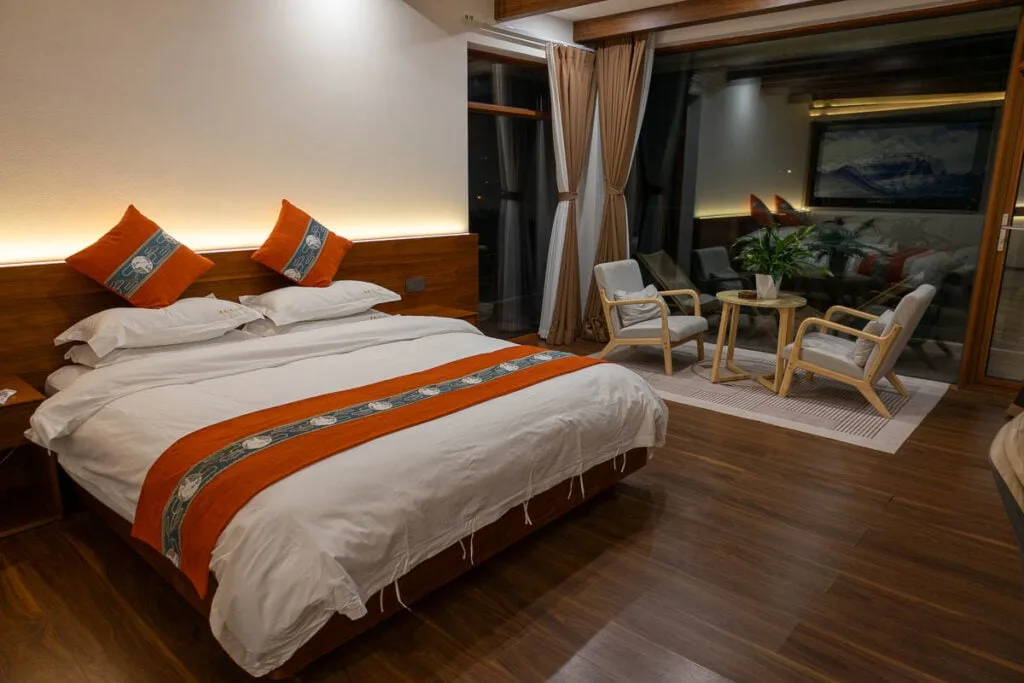
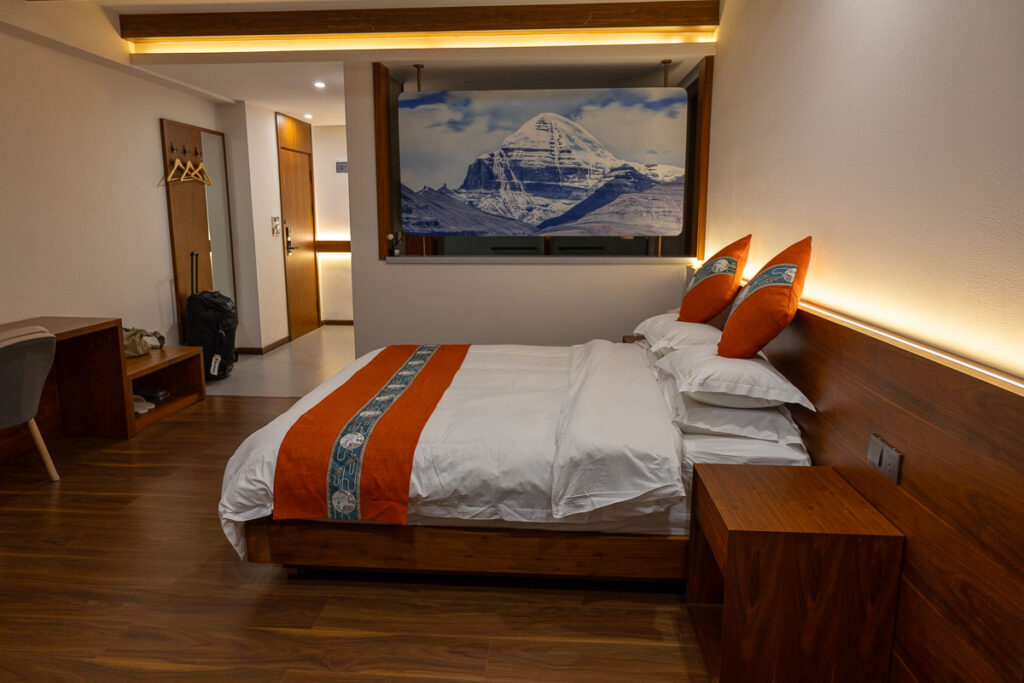
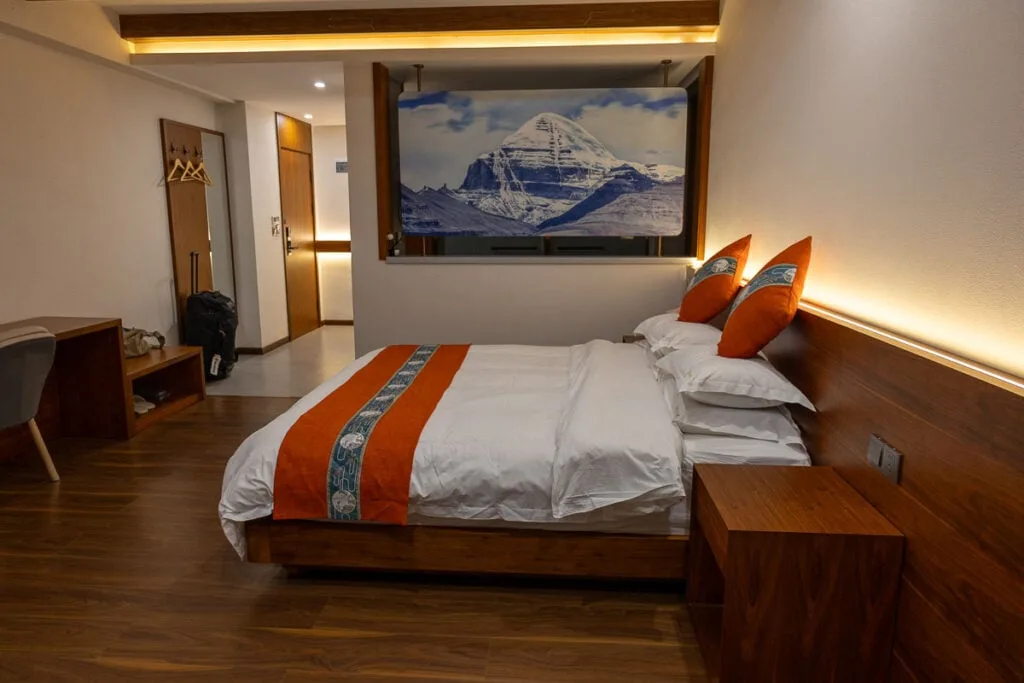
We stayed two nights at Xingshan Ji Hotel, a modern, newly-opened, hotel just outside town. My room had far-reaching views of the grasslands and mountains and I woke to see yaks grazing outside. I was pleased to have in-room oxygen given the higher altitude in Tagong.
Day 3: A day spent with a family of nomadic yak herders
This was one of the most memorable days of our China itinerary and for so many reasons. After driving into the vast plains and a short hike, we spent the day with a local family of yak herders and immersed ourselves in the culture of the grasslands.
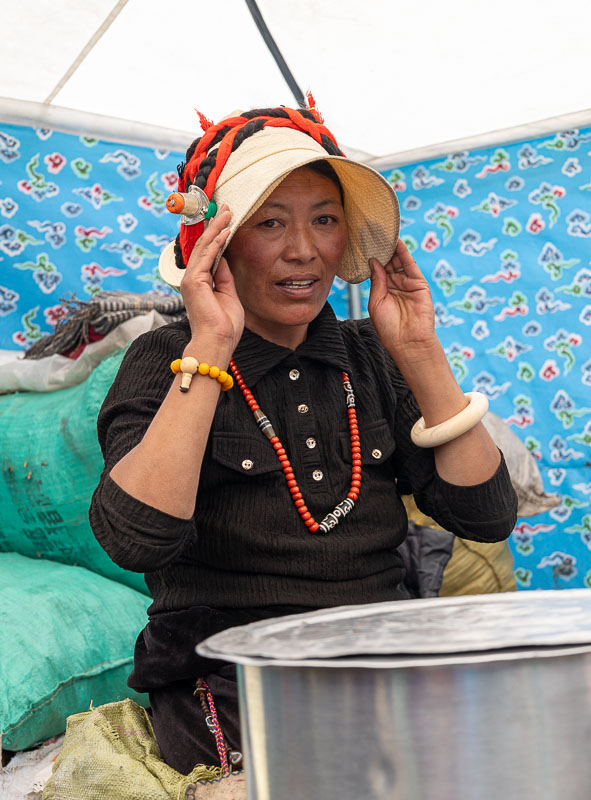
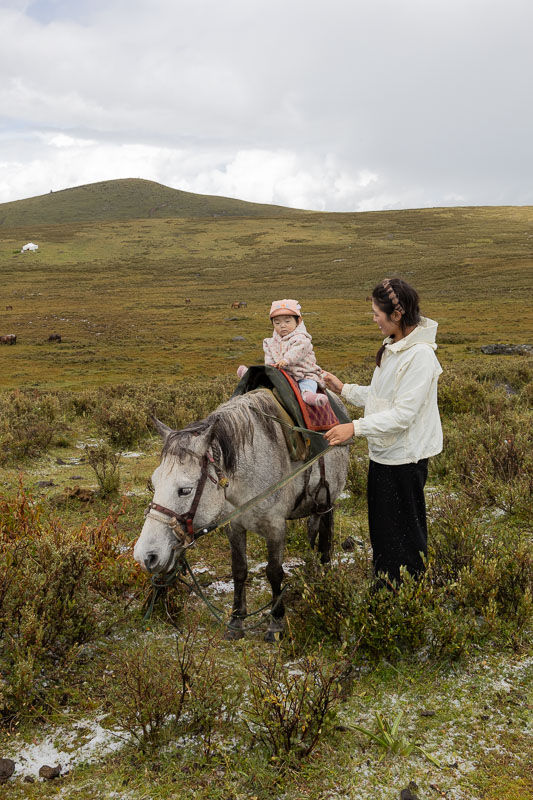
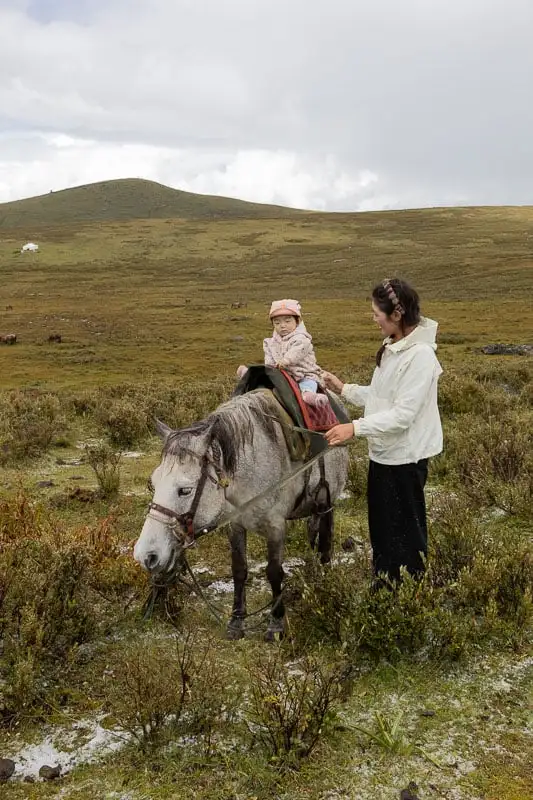
The family was made up of the parents and their two adult daughters, one of which had a sweet baby girl, maybe six months old. They taught us how to milk yaks (harder than it looks) and how to herd yaks (even harder than milking yaks).
When hail pounded down we sheltered in the cosy family tent sitting on cushions and rugs. We learned how to make tsampa, butter tea, cheese and yak butter as the heat from the dried dung fuelled fire warmed us.
We could see one of the horses through the open flap of the tent, the scenery in the distance misted with hail, the earth whitening as we waited for a break in the weather.
Tsampa is a Tibetan staple food made from roasted barley flour. Mixed with butter tea, cheese and sugar it makes a kind of cookie dough and is incredibly nutritious. It’s often served with yak milk yoghurt which is scooped up with the tsampa.
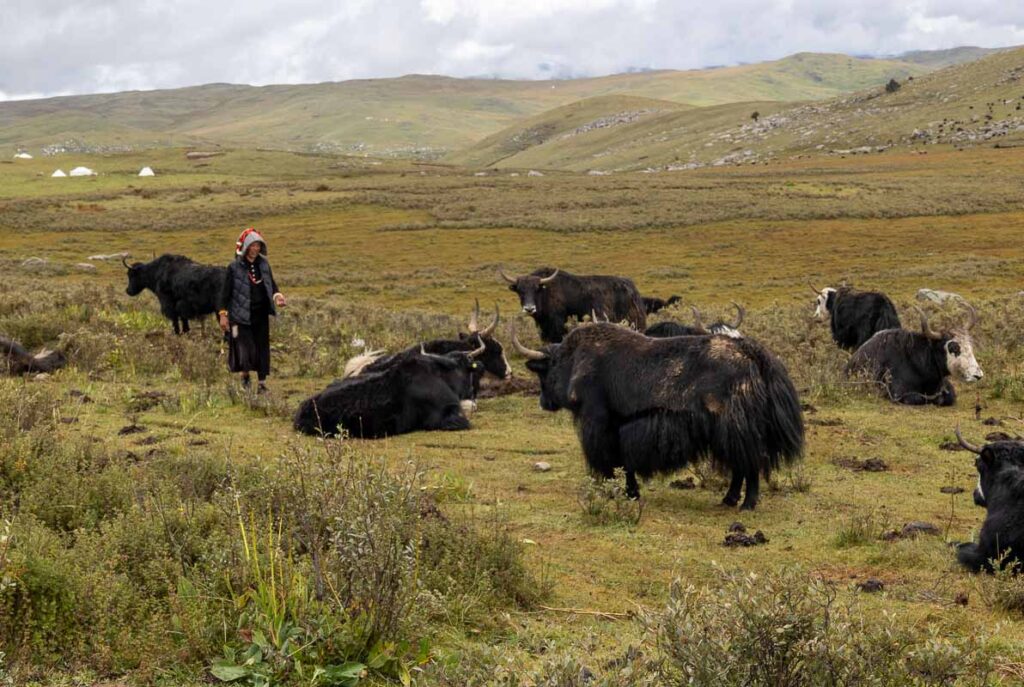
While we sat around the fire preparing food the baby girl played with the family’s pet kitten. Her grandfather looked on rhythmically moving prayer beads through his fingers as he watched.
The family were kind, welcoming and incredibly hard-working. We felt very relaxed in their company, helped along by our guide and interpreter.
Dinner that evening was one of my favourites of the trip; a spread of authentic Tibetan food at a restaurant in Tagong town.
Day 4: Tagong to Litang
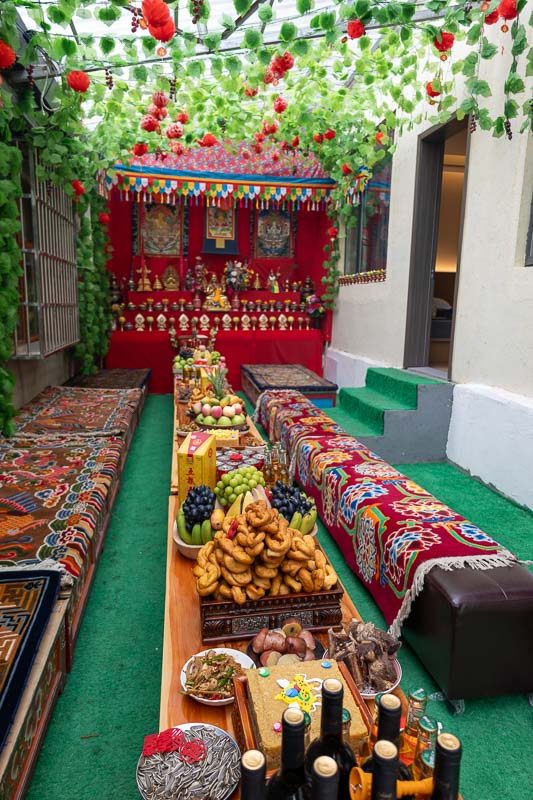
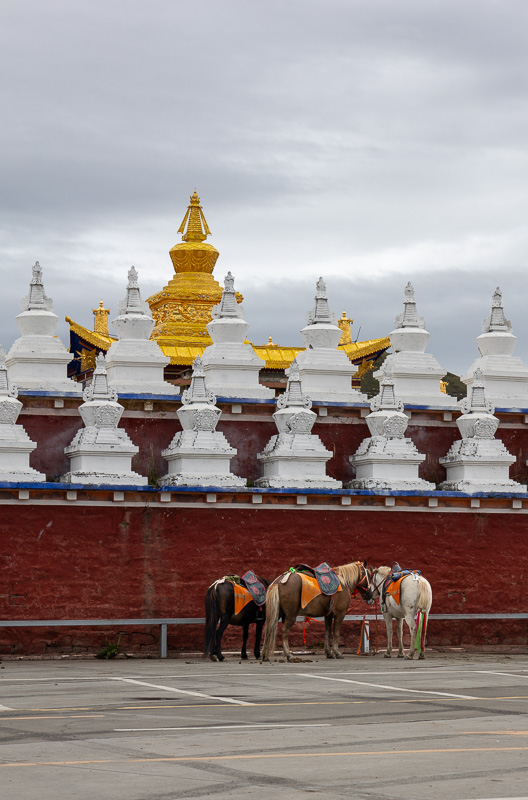
There’s a Tibetan wedding in town and before leaving town we check out the preparations. It’s a colourful affair, enough food to feed a village and an excited buzz in the air.
Folk are dressed traditionally with many wearing cowboy-style hats, boots and chubas (long robes). The women’ s hair is worn in two long plaits with red wool threaded through it.
We’d have loved to stay for the ceremony, we had invites, but we need to continue on our journey, westwards to Litang. It’s a five-hour drive passing through the ‘18 Bends of the Heavenly Road’.
The road follows the Liqiu River and we stop in Yajiang for lunch. The area is known for its mushrooms and a huge pot of silky chicken broth arrives swimming with mushrooms, ginger and spring onions. It’s divine and sets us up nicely for the rest of the journey.
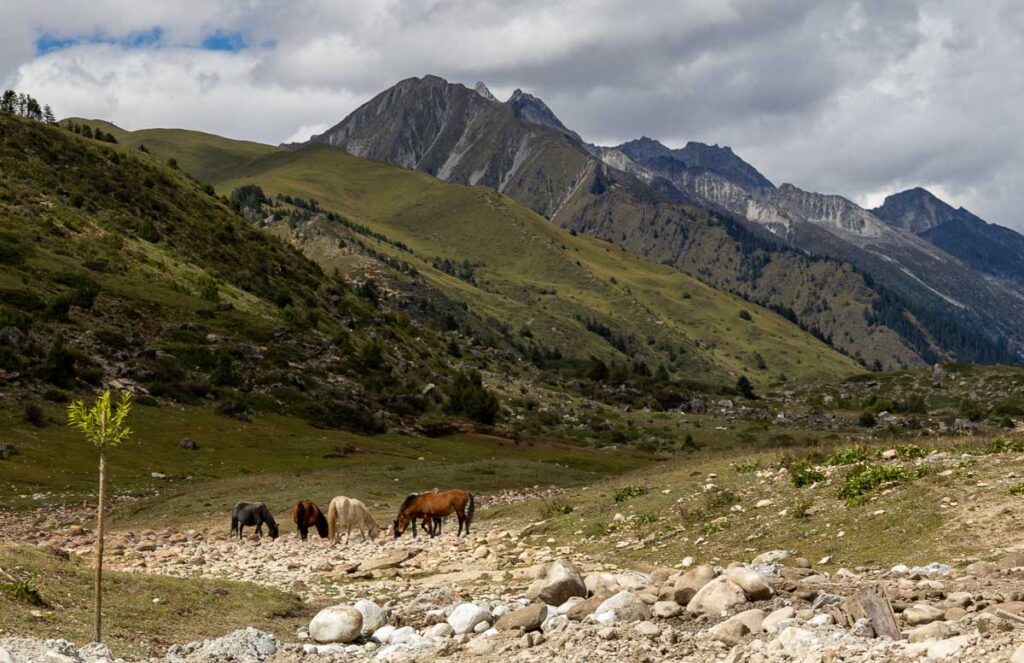

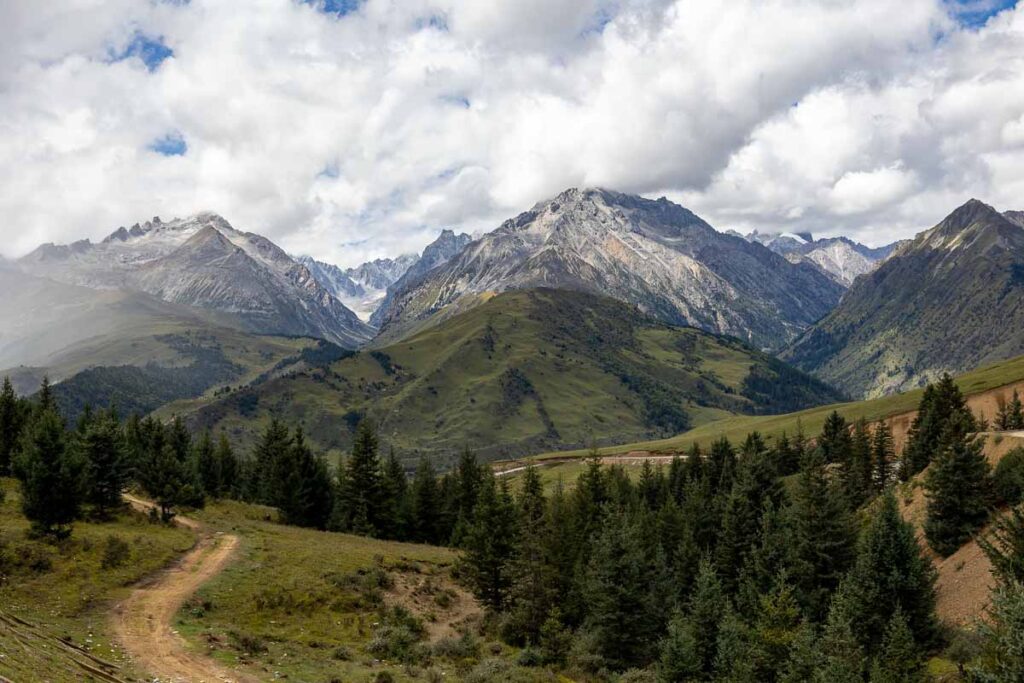
The scenery is constantly changing and it’s stunning. I felt like I was in the French Alps with forested mountains and lush green valleys stretching into the distance. Fluttering prayer flags and yaks along the roadside bring back a sense of place.
The elevation hits new highs and we reach 4,700 metres. There’s a pit stop for photos, and I catch my breath – at both the lower oxygen levels and the cold!
As we head over the mountain pass and back down to lower levels the scenery changes again, reminding me of the Scottish Highlands. We arrived in Litang, the cultural centre of the Kham Tibetan region late in the afternoon.
Charming Letong Ancient Town

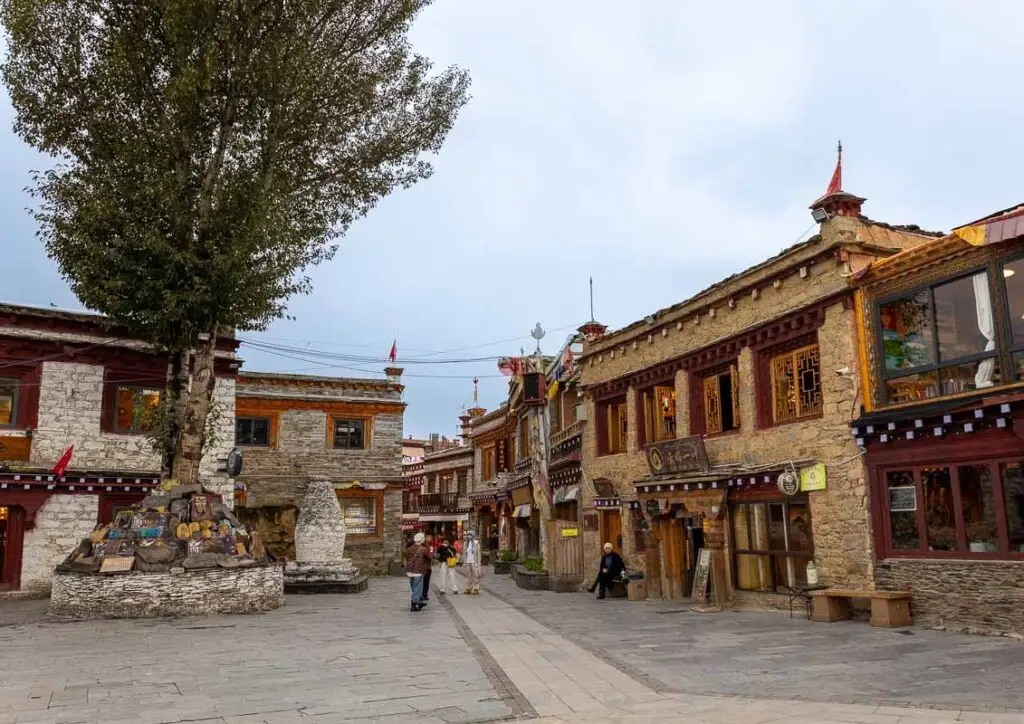
After checking in at the hotel we head straight out to explore. Over a thousand traditional Khampa-style buildings fill the streets and alleys of this authentic ancient town which is the birthplace of the seventh Dalai Lama.
We wander the quaint streets of Letong old town and Qianhu Tibetan Village, dipping into temples and museums as dusk gently falls and the town begins to gently illuminate.
Shops selling locally made jewellery, yak milk soaps and crafts line the streets of this charming little town and I buy some bracelets as gifts. There are bookstores and coffee shops all beautifully decorated in typical Tibetan style. Prayer flags drape over the lanes, and prayer wheels turn, their bells ringing. In the main square mani stones are piled around the trunk of a tree.
We stop at a traditional Tibetan restaurant where a fire roars in the corner. Dinner is a tasty hot pot with comforting sliced potatoes in a spicy sauce, yak meat and wraps.
Guozhuang Dancing
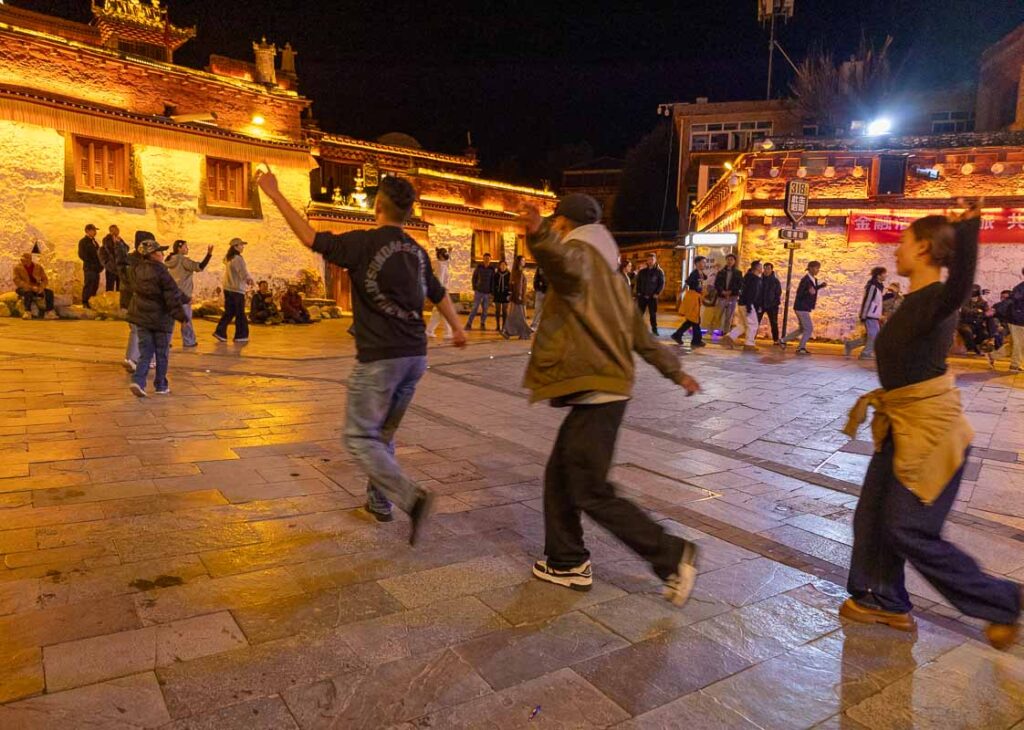
As we stroll back to our hotel,we see people dancing in the square. This small but lively tradition has local people dancing the Guozhuang in a large circle. It’s very casual with people joining and leaving at will and very charming.
Later on in our trip, in Dege, we pass a primary school where children in the playground are learning the dance. It makes me happy to see this tradition continuing down the generations.
Accommodation in Letong Ancient Town
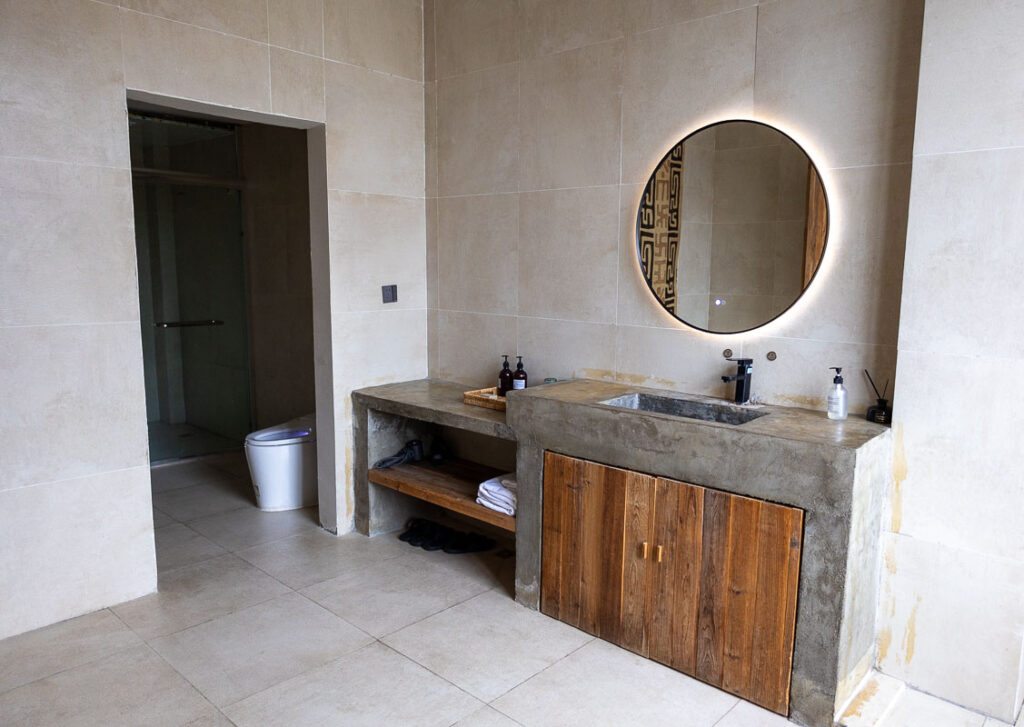
Our accommodation in Letong, the Muzhe Hotel, sits inside the Thousand-Household Tibetan Village just steps away from restaurants, museums and sights of the town. It’s stylish, contemporary and comfortable with authentic Tibetan influences.
Day 5: Litang to Zeba village with time at Changquingchunkeer Monastery
Our first stop today is Changqingchunkeer Monastery, just a short drive from the hotel. It’s one of the oldest and most important Yellow Hat (Gelug) Tibetan Buddhist monasteries in Kham.
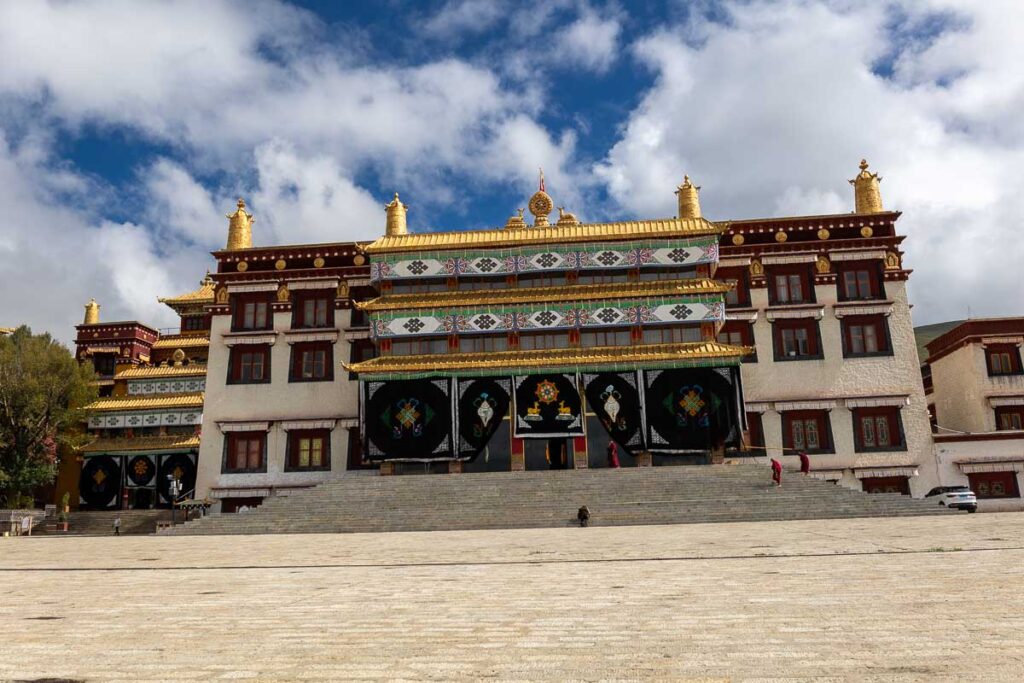
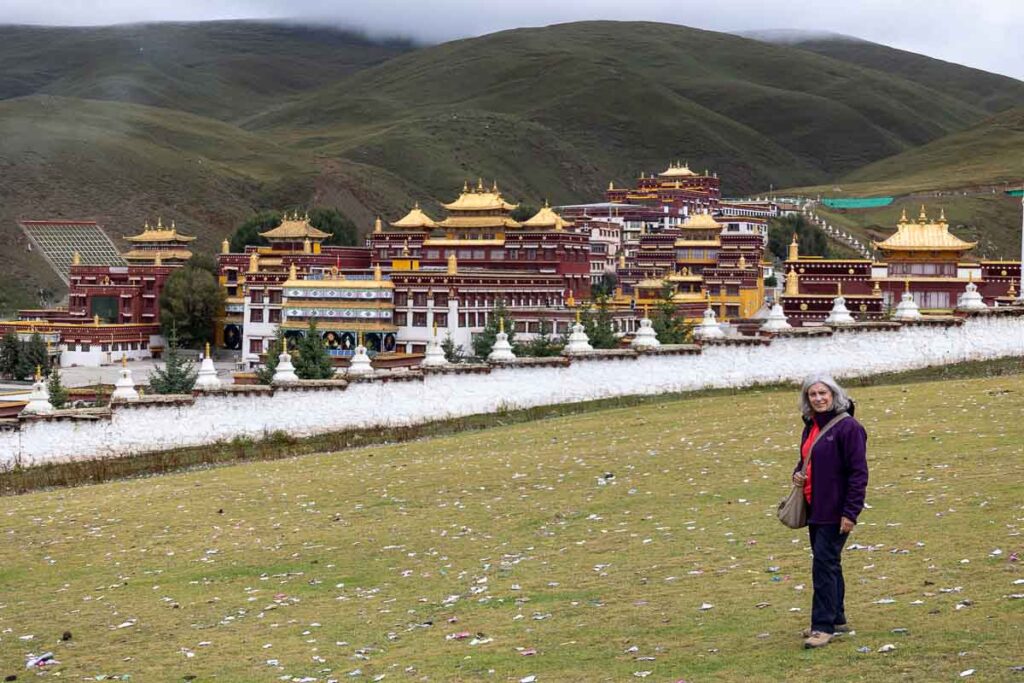
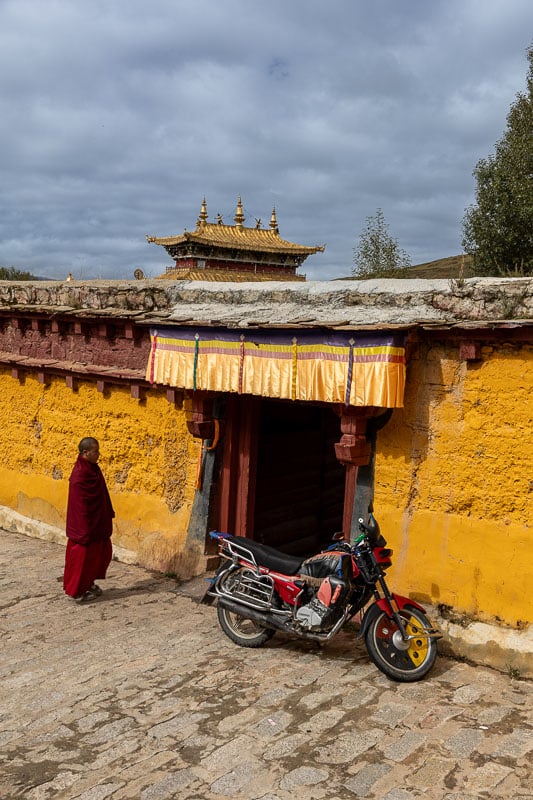
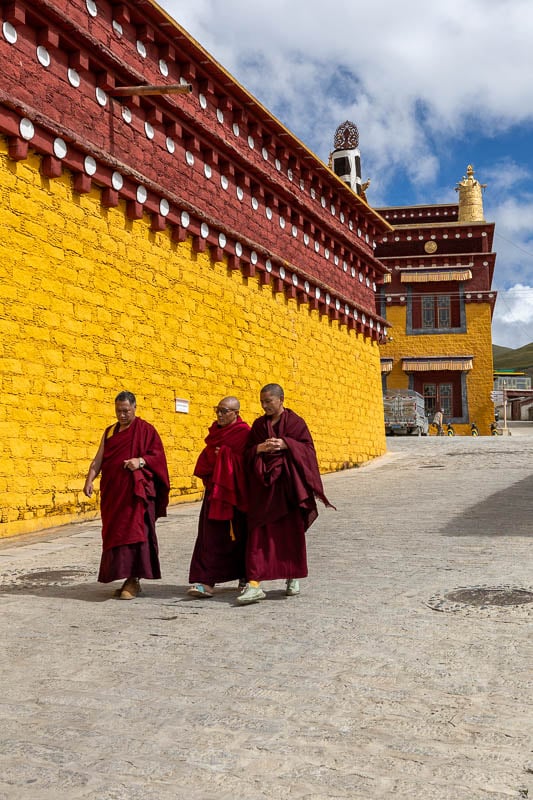
Built during the Ming Dynasty, this temple complex is home to hundreds of monks and it’s huge, like a small village. The main halls are incredibly ornate and full of detail, colour and texture with carvings, murals and huge buddha statues lining the walls.
There are no prayers taking place but we see many monks going about their day to day chores, heads shaven, their maroon robes flowing.
We check out the impressive Changqingchunkeer from the outside. There’s a giant tent of prayer flags nearby and I duck through a gap and enter. There’s a young yak inside, the grass is littered with rice paper prayers and there’s a central spiral staircase.
Where there’s a view I will climb, and I head upwards but the altitude is over 4,000 metres in Litang and it’s hard going. I stop every 6 steps to catch my breath, but the views of the monastery and the city are worth the effort.
A yak with issues
I get my shots and go to leave but the yak is guarding the exit. I move closer but it bows its head in a butting motion. I notice its horns and realise I’m trapped by a yak! A few minutes pass and I call out to my travel mates, but nobody hears. Eventually the yak decides the grass looks greener on the other side and I make my escape!

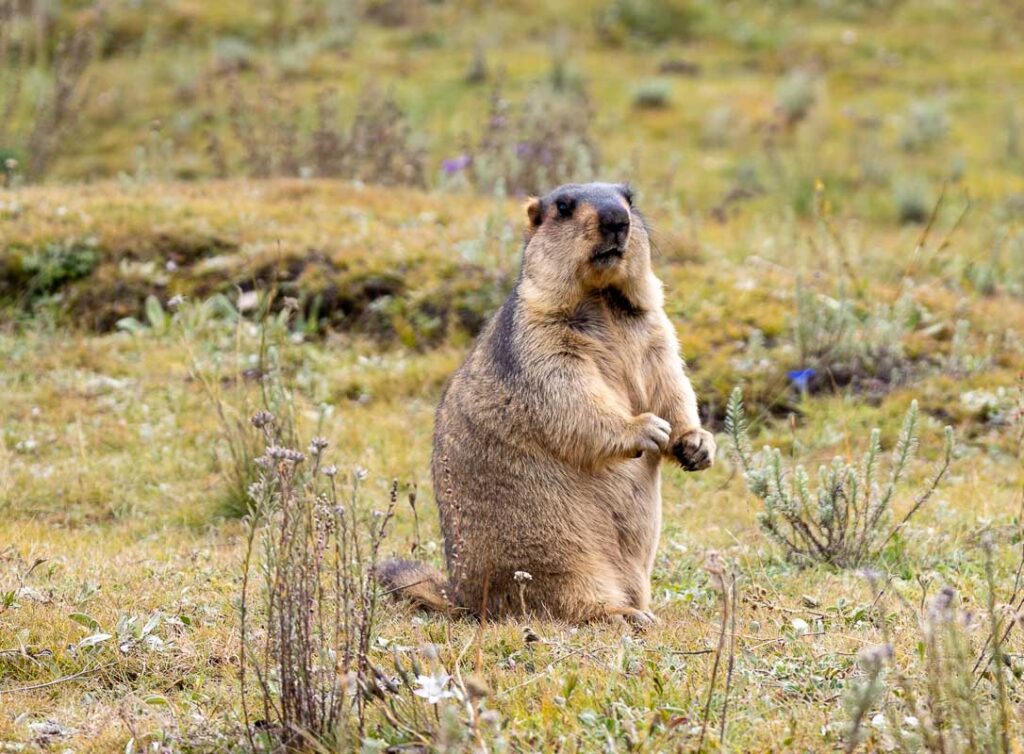
The drive to Zeba has some of the most extraordinary scenery, constantly changing and frequently breath-taking. There are many photo stops which our driver is happy to do when it’s safe. There’s wildlife too and we see a family of marmots on the hillside. My first ever sighting!
The Eye of Genyen
The next highlight on our China itinerary is a stop at the Eye of Genyen. This natural phenomenon sits surrounded by snow-capped mountains, forests and hills. The ‘eye’ is an alpine lake which looks just like a clear, unblinking eye set within vast meadows surrounded by mountains and rolling hills.
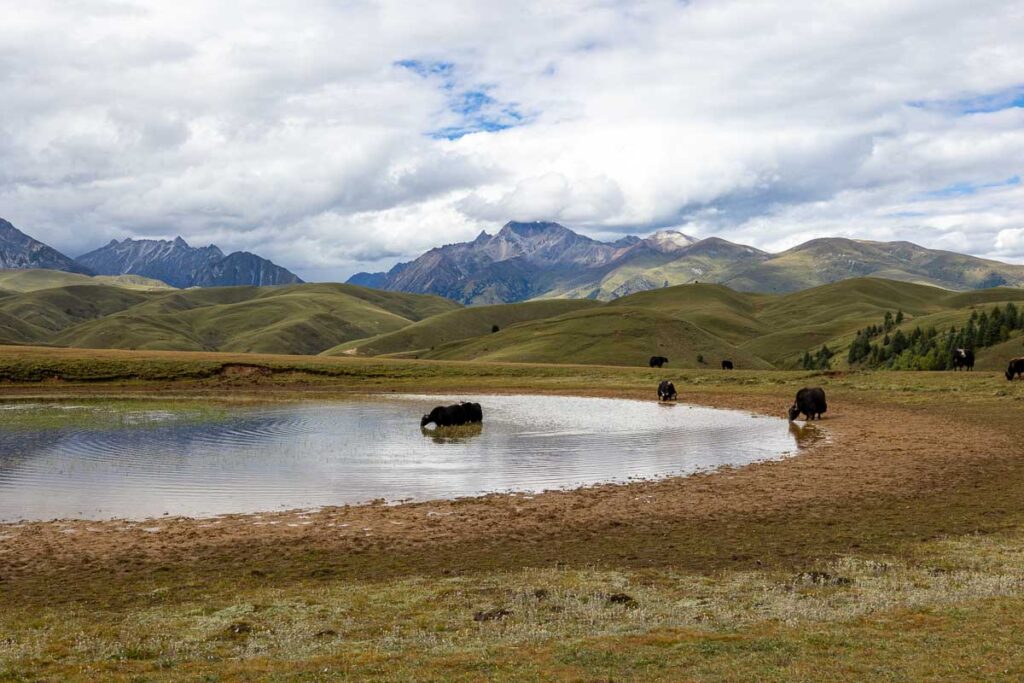
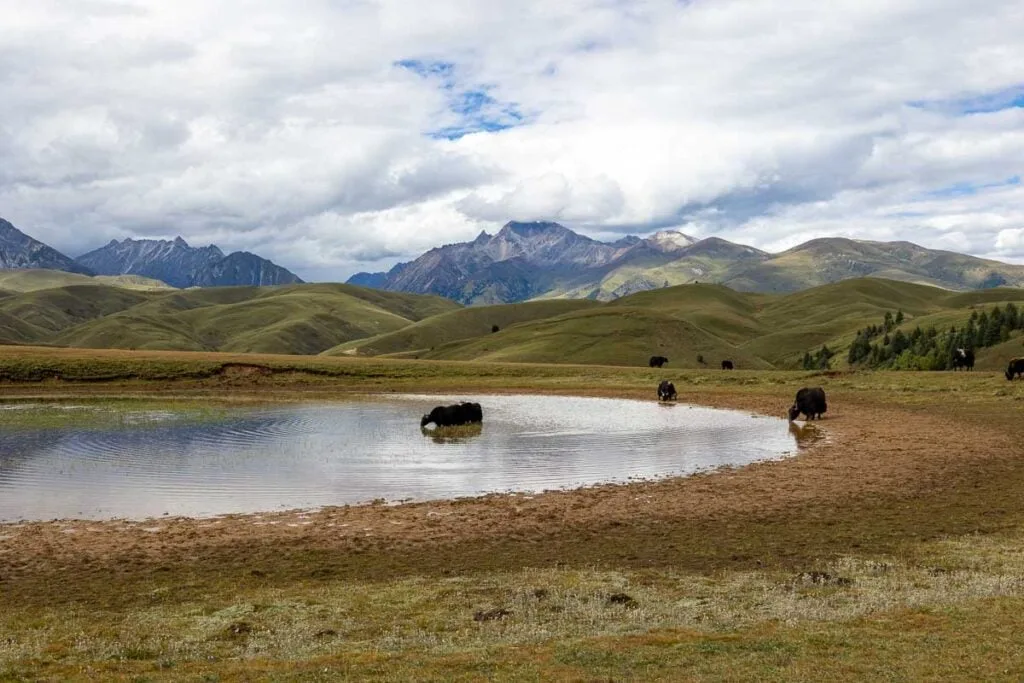
Sadly, we weren’t lucky enough to see blue sky reflections to get ‘the eye’s’ full watchful impact. That’s best enjoyed from drone footage. Continuing we passed more beautiful Alpine scenery along the southern route of Mount Genyen before arriving in Zeba village.
An evening hike
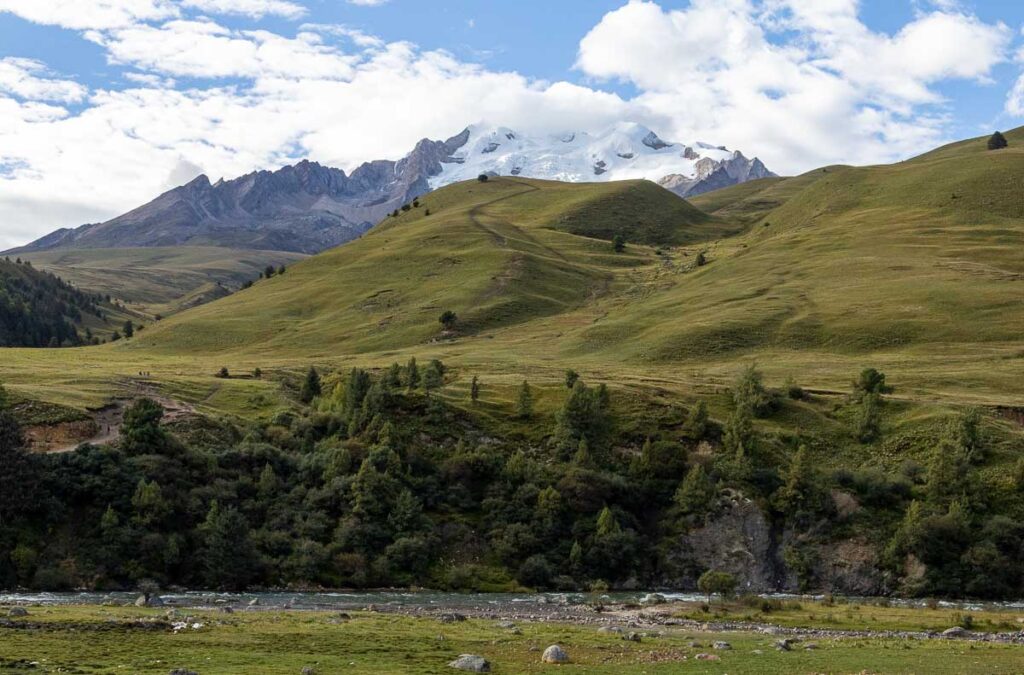
It was time to get a little closer to Mount Genyen and its glacier and we headed off on a late afternoon hike up the hill. It was hard-going due to the altitude, and we made frequent stops but I made it to the top for 360º views of the mountains and over the village.
We’d earned our supper for sure and filled up on excellent Sichuan food before an early night. We’ll be hiking again tomorrow…
Accommodation in Zeba Village
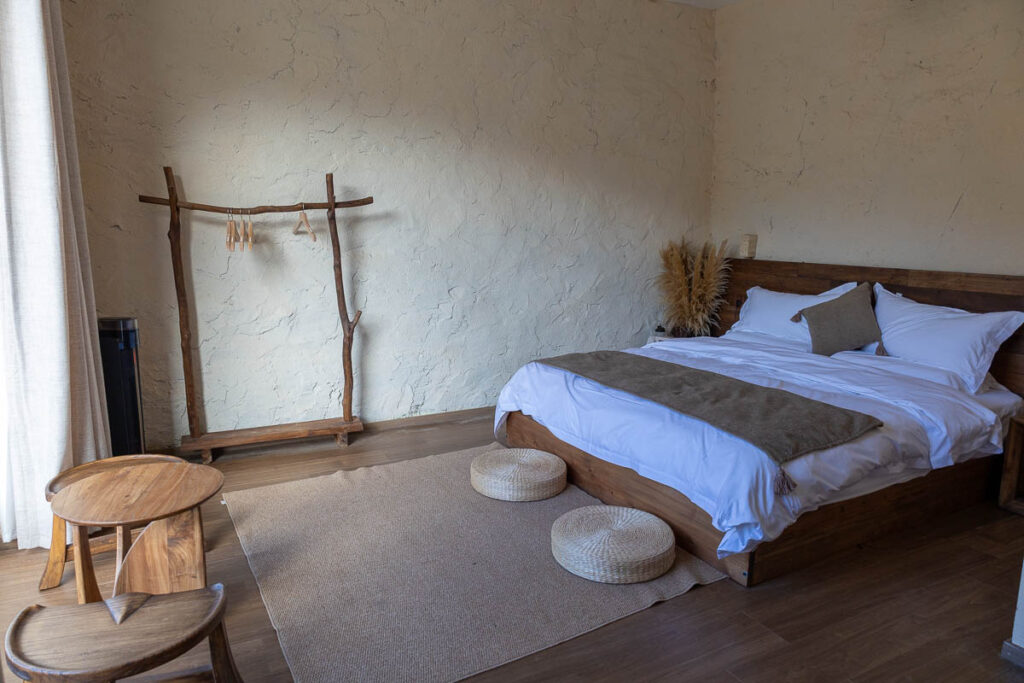
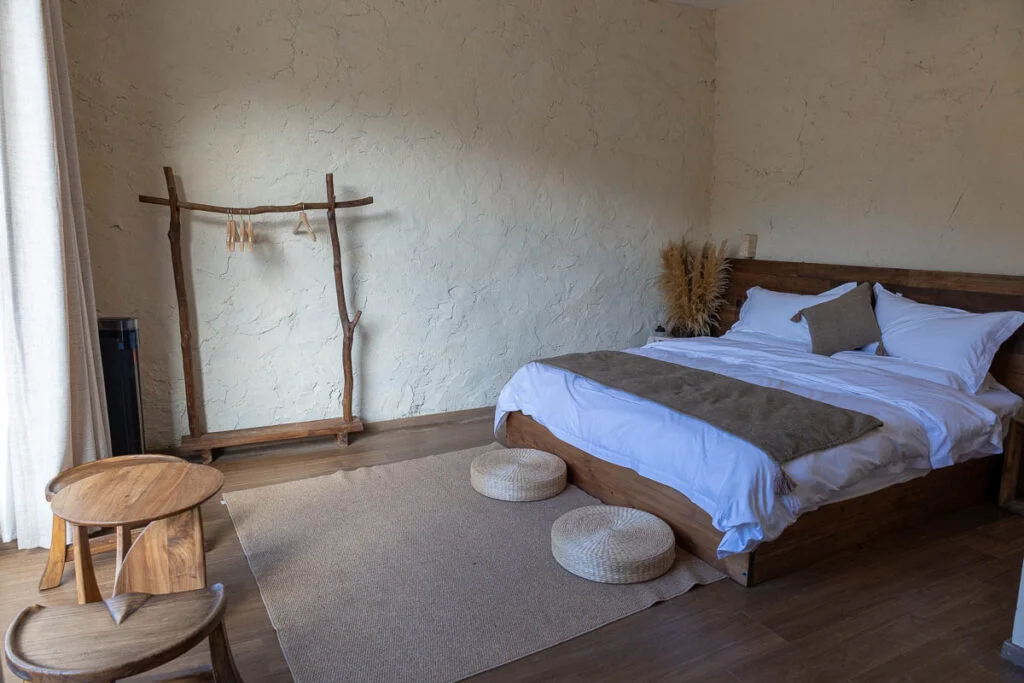
The Shanyu Guesthouse, in Zeba Village, has gorgeous Mount Genyen views. The rooms are rustic and stylish but contemporary and comfortable with heaters and oxygen supplies.
Day 6: Zeba Village to Batang
There are two monasteries at Lenggu and they make up one of the most important spiritual sites in Tibetan Buddhism, favoured by high-ranking lamas as a meditation retreat.
New Lenggu Monastery and its treasures
New Lenggu which sits at the base of the mountain was our first stop and we were lucky enough to be shown the Three Sacred Treasures of Mount Genyen by one of the monks.
A Left-Turning White Conch: A rare natural relic, said to have been found inside solid rock.
A Female Deer Antler: Very rare, as most female deer don’t have antlers – a powerful symbol of purity and rarity.
The Helmet of King Gesar: A sacred artifact believed to be linked to the legendary Tibetan warrior-king, whose spirit is revered in Tibetan folklore.
We also see the Heart of Genyen, a smooth, naturally polished stone resembles the human heart. It was discovered in the mountain during the monastery’s construction and is revered as the “spiritual heart” of Genyen.
A hike to Old Lenggu Monastery
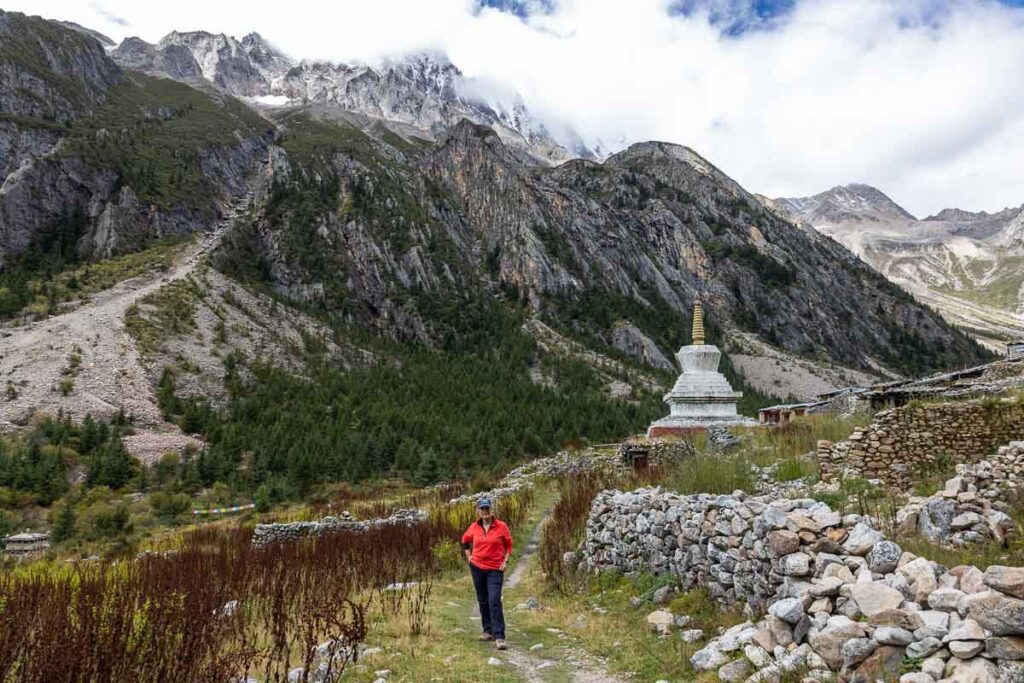
A hike up through the valley alongside a stream led us to Old Lenggu Monastery. We could’ve paid to get a lift on the back of a motorcycle, but the scenery was incredibly beautiful, and I didn’t want to miss any of it.
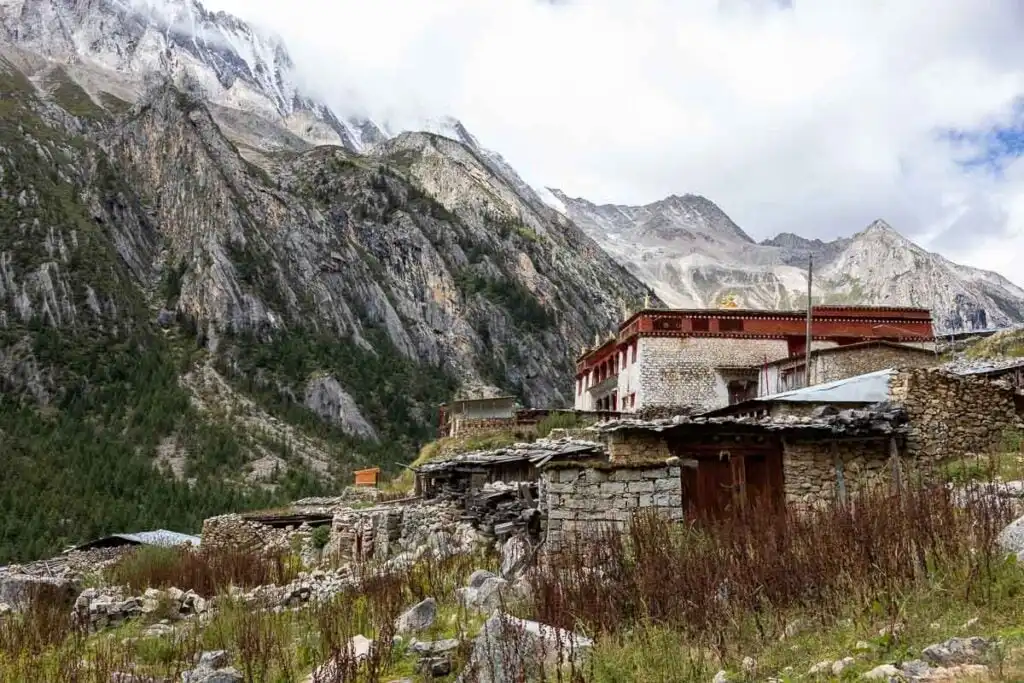
The ruins of a small village surrounded Old Lenggu and the murals around the entrance were faded and worn. Stepping over the threshold we entered the darkened hall and walked clockwise towards the altar.
A monk approached from the shadows and handed us an incense stick which we lit from a candle and placed in front of the altar. A surreal moment.
As we stepped out into the light, we looked down over the route we’d just hiked, surrounded by mountains, a sparkling stream wending its way into the distance. Behind us a snow-capped mountain range completed the scene.

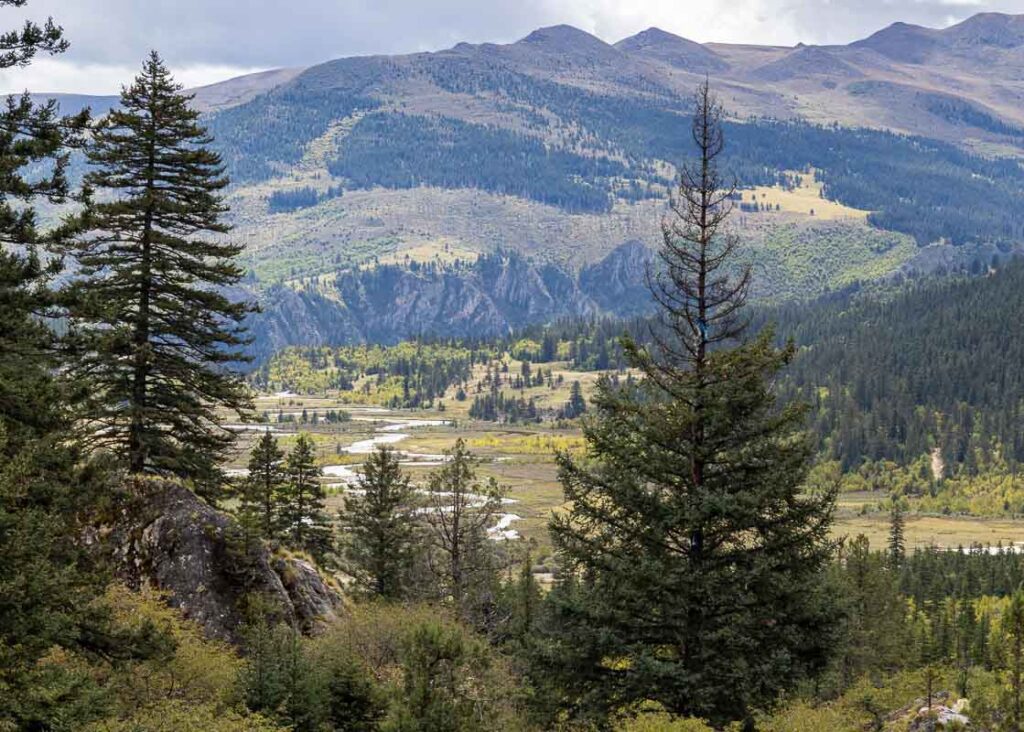
Happily, the return route was mainly downhill. We were ready for lunch after the drive back to Zeba village and we tucked into an excellent meal. Stir-fried veg and beef, beanshoots and scrambled egg and tomatoes with Mount Genyen views. On full bellies we loaded up the car ready for our next stop. Batang was calling.
The road to Batang
The reason that more remote areas in China are opening up to visitors is that there are many new roads making them more accessible. There are some that are more dirt tracks than road. The first 10km of our journey from Zeba to Batang took nearly 2 hours.
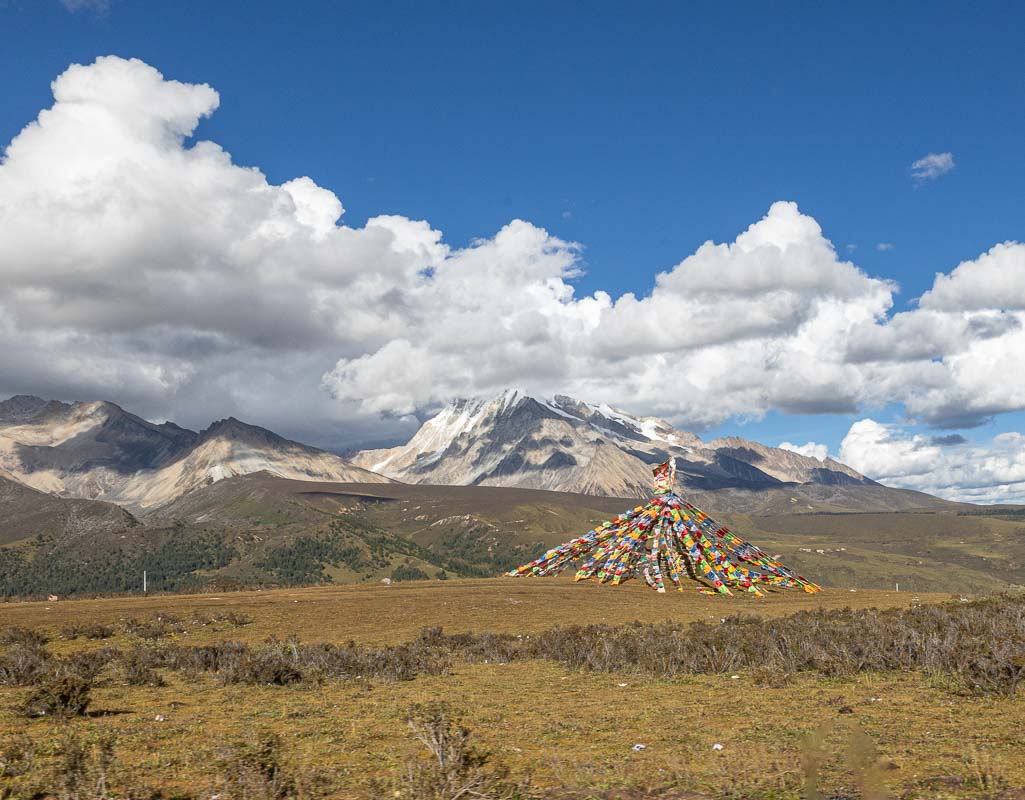
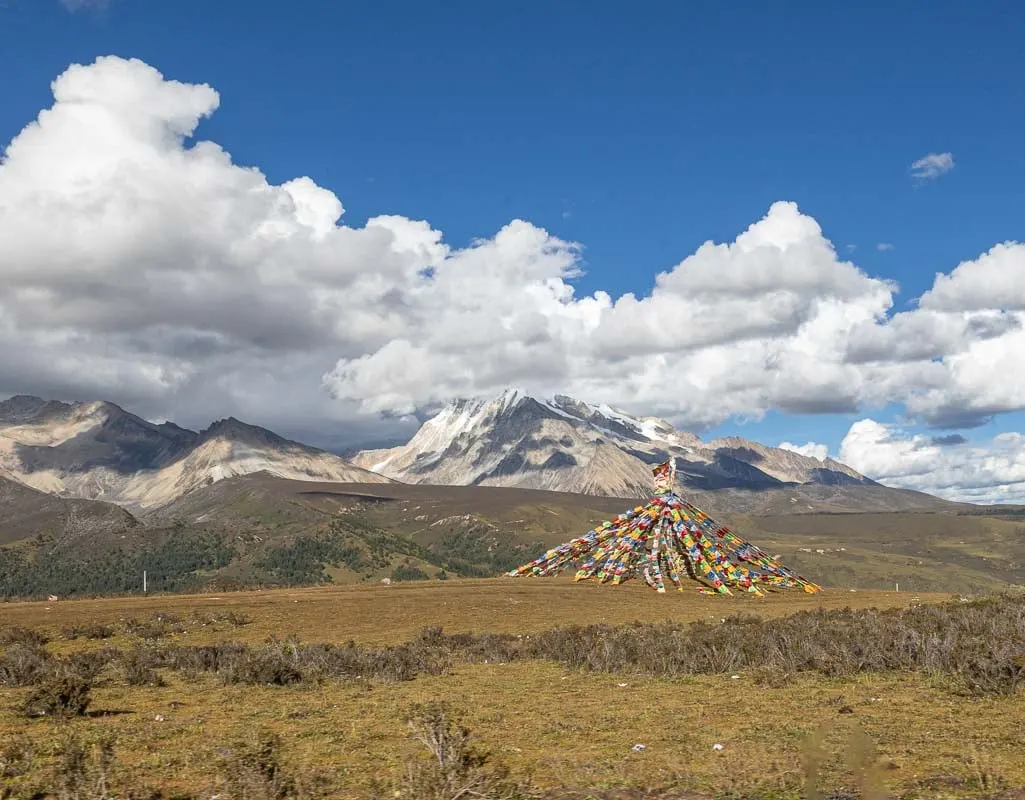
However, the scenery is especially beautiful and constantly changing. Tree-lined rivers and mountains open up to sweeping plains with herds of grazing yak framed by distant mountain ranges. By early evening we were driving through a rocky, barren mountain pass before descending switchback by switchback into Batang.
Batang County, located in the western part of Sichuan Province, lies at the junction of Sichuan, Tibet, and Yunnan. It’s known as the “Jiangnan of the Plateau” and the “Colourful Tibetan Land”.
We arrive at our hotel and eat there; it’s been quite a day hiking at high altitude and the long winding drive. Z orders for us and we dine on tofu, fish stew, chicken with spring onions and peanuts and something I probably wouldn’t have ordered myself. Fermented eggs.
I’m always open to trying new foods when I travel but would probably have drawn the line at the dark green eggs with black yolks. But they tasted quite good despite their slimy texture.
Accommodation in Batang
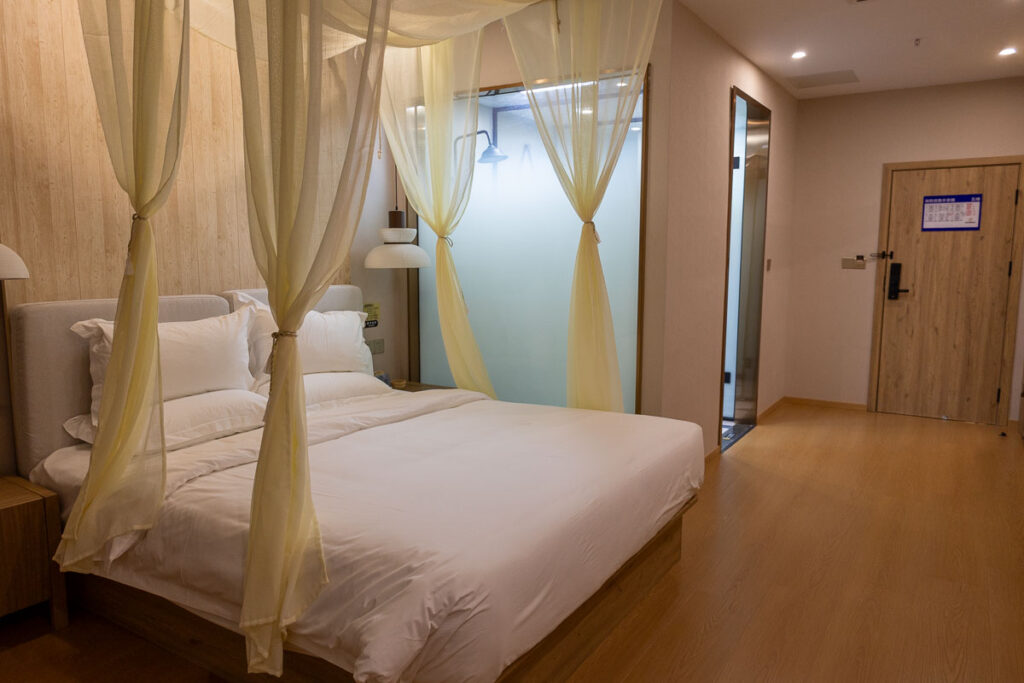
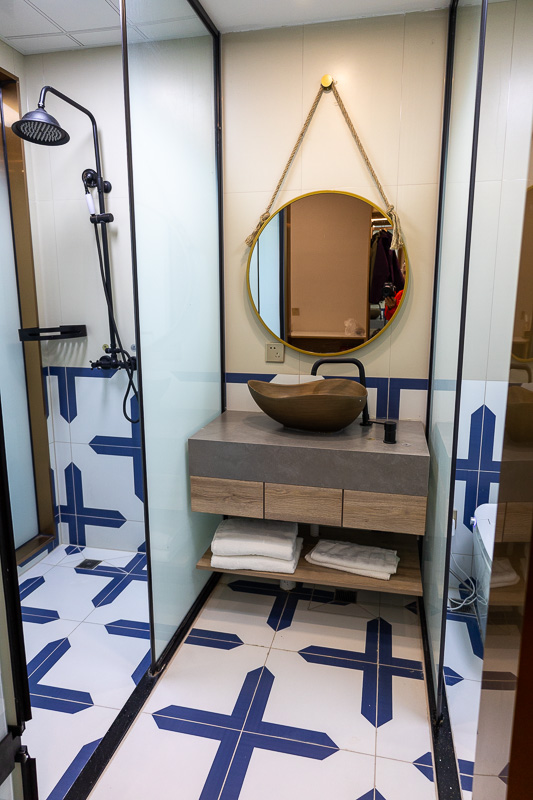
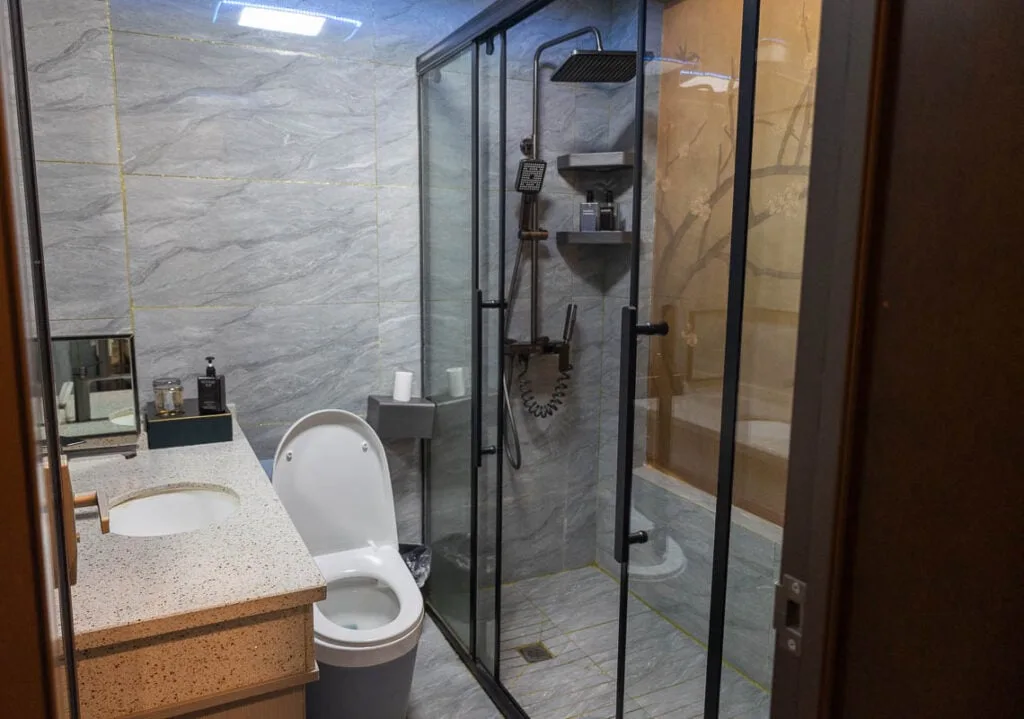
We spent one night at Chanjing Gushu Oxygen Hotel in Batang. The rooms were spacious, stylish, modern and comfortable. I made use of the oxygen machine which aided a very good night’s sleep.
Day 7: Batang to Baiyu
Today we journey from Batang to Baiyu visiting two monasteries en-route. The first, is Baiyu which was founded in 1675, sits on a hillside right in the middle of town. The name “Baiyu” is the Chinese translation of Tibetan for “Auspicious Land.”
Baiyu, a Monastery in the city
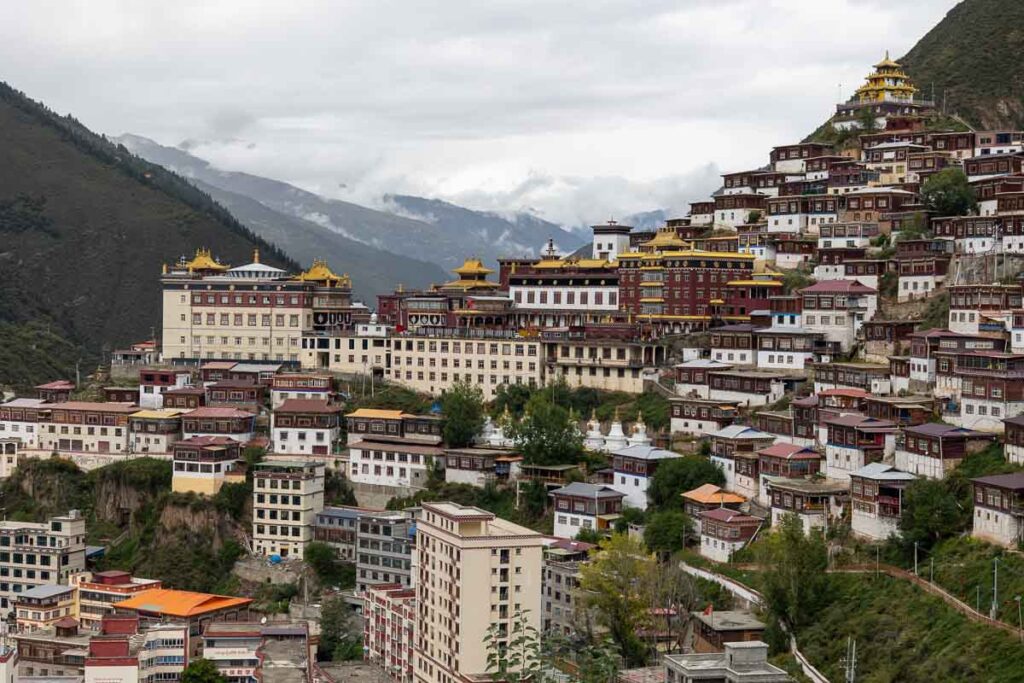
From the monastery terraces there are sweeping views of the town below. As we wait to enter a group of women are gathered at the threshold. I can see them looking at my clothing which must look very odd to them. But they’re friendly and curious, smiling when I catch their eye. There aren’t many foreigners round here.
After our visit we go to a viewpoint looking up towards the monastery which blends seamlessly with the town’s dwellings with rows of houses clinging to the mountain slopes. The view is captivating. There’s a cat sleeping on a motorbike and a group of young boys call out ‘hello’ shyly to us and run away laughing.
Katok a Monastery on a mountain
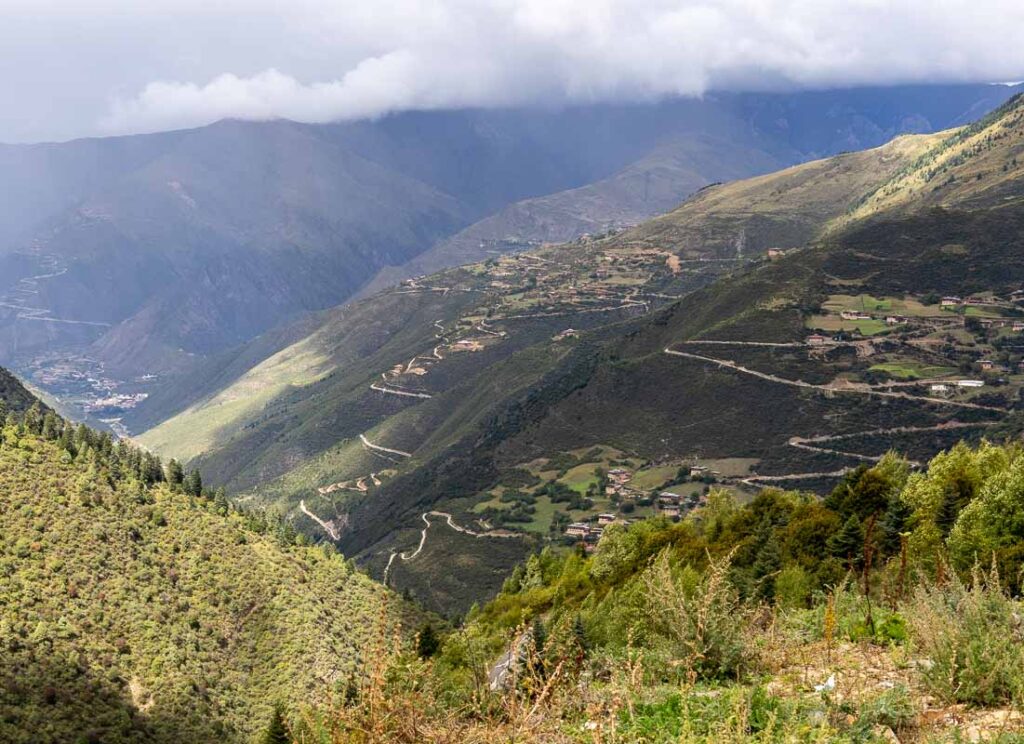
Contrastingly, Katok Monastery, our next stop, is miles from anywhere and sits at the top of a mountain peak just over the ridge from Tibet at an altitude of 4,200 metres. And today I’m feeling it for the first time with a niggling headache that just won’t shift.
We gingerly drive up the mountain’s 18 hairpin bends to the monastery marvelling at the cars full of monks racing down in the opposite direction. Some wave, all are smiling. I guess they know the road well. A final turn and the monastery sits before us. It’s one of Sichuan’s most scenic and one of the most ornate we see on our trip.
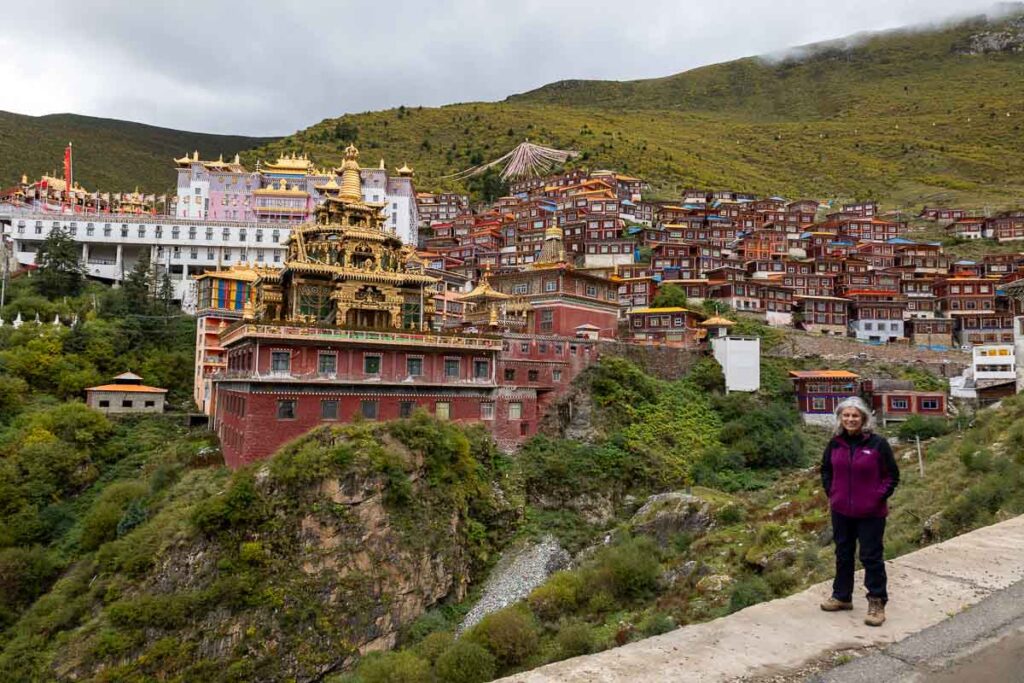
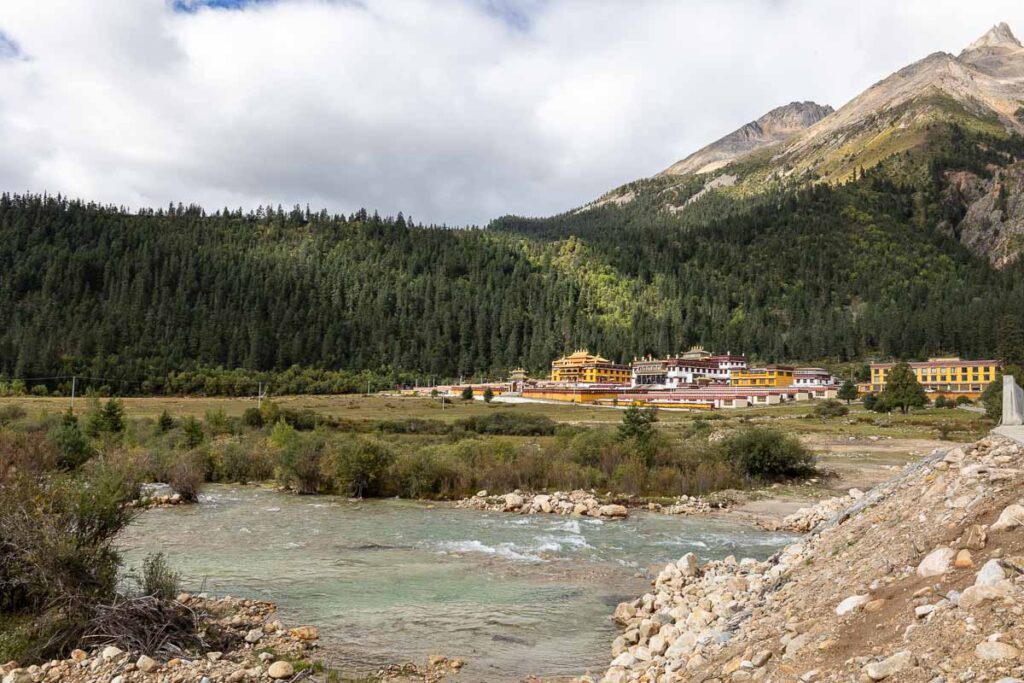
Katok is the mother monastery of the Nyingma school of Tibetan Buddhism founded in 1159. It’s gold rooftops shimmer against the green mountain hills and is quite a sight as we approach. We see ornate gold encrusted temples and an opulent, colourful prayer hall.
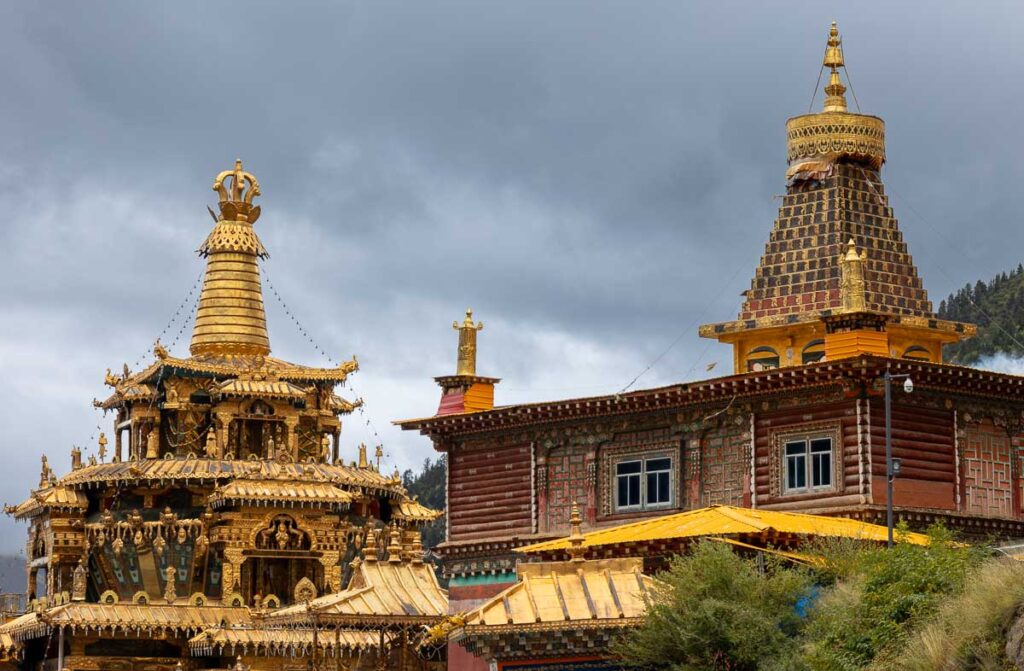
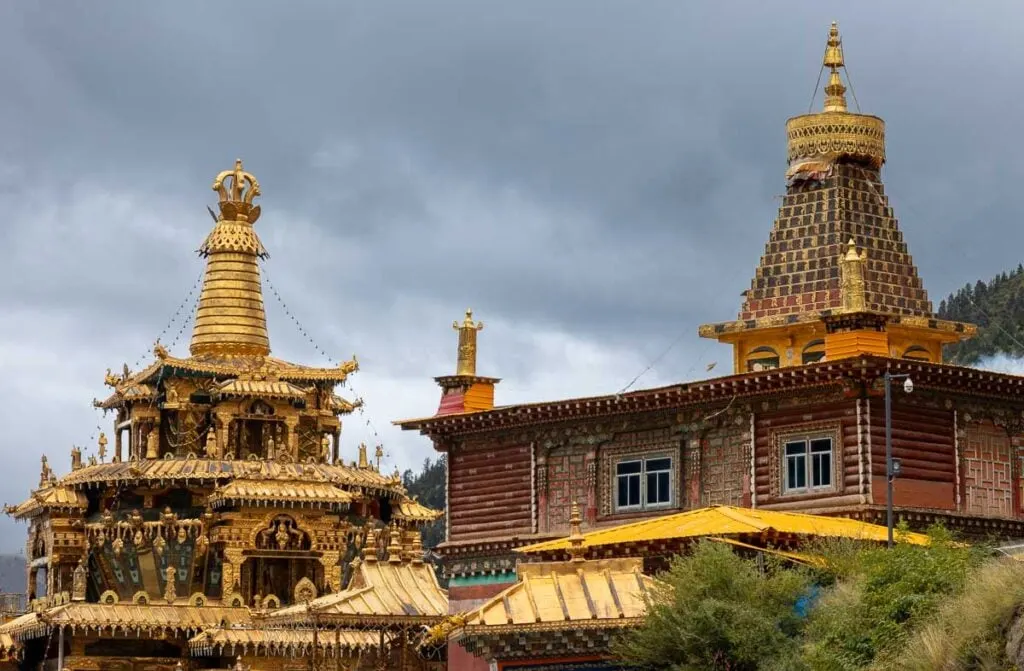
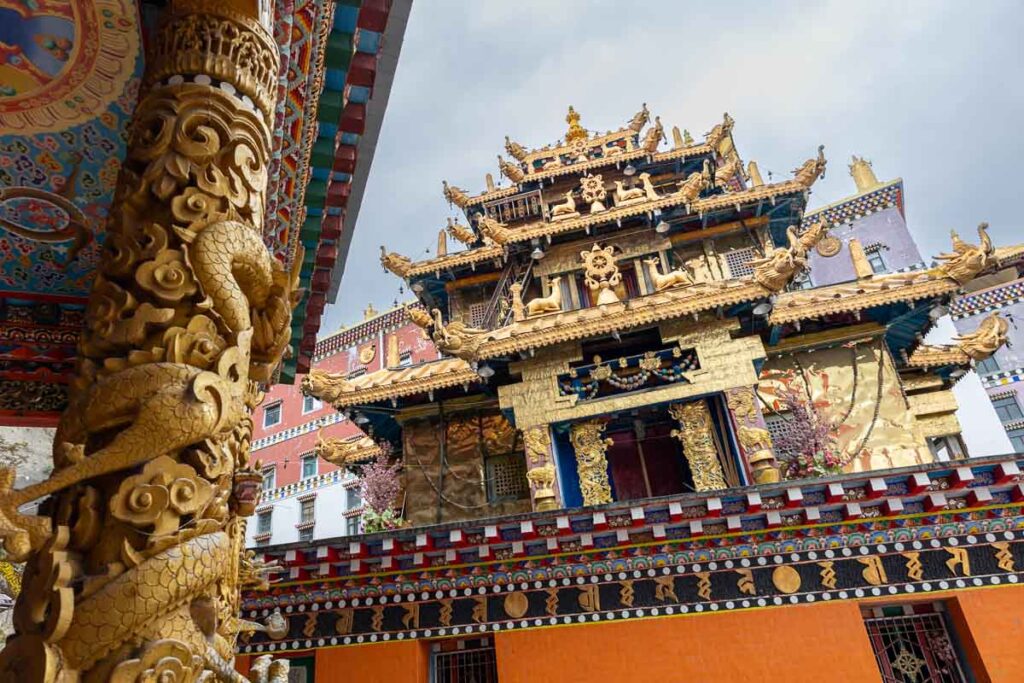
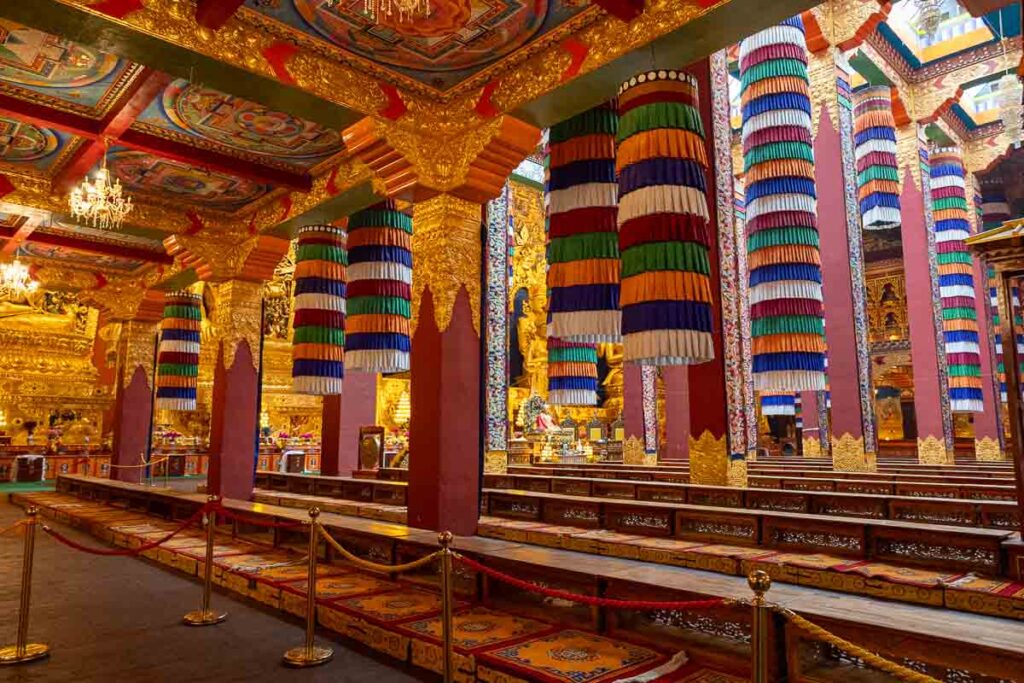

Monk’s accommodation is spread across the mountainside in neat terraces and other more traditional Tibetan homes painted maroon and saffron spill down the hillside.
We arrive back in Baiyu early evening, and I like the feel of this town which is on the Sichuan Tibet border. We’re getting many surprised glances, but we’re used to it now and find it amusing.
We eat at a small restaurant on the main street and have one of my favourite dishes of the trip, vegetable hot pot. It’s a dry dish with warm mellow spices and we enjoy it with salty green beans, peppers and a tender pork dish.
Accommodation in Baiyu
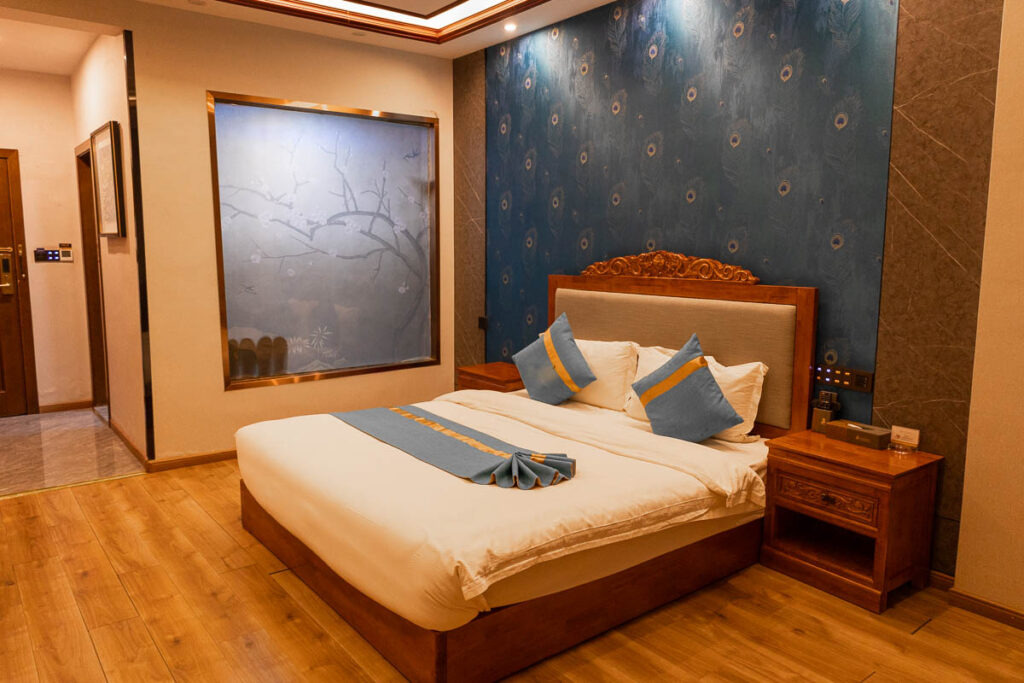
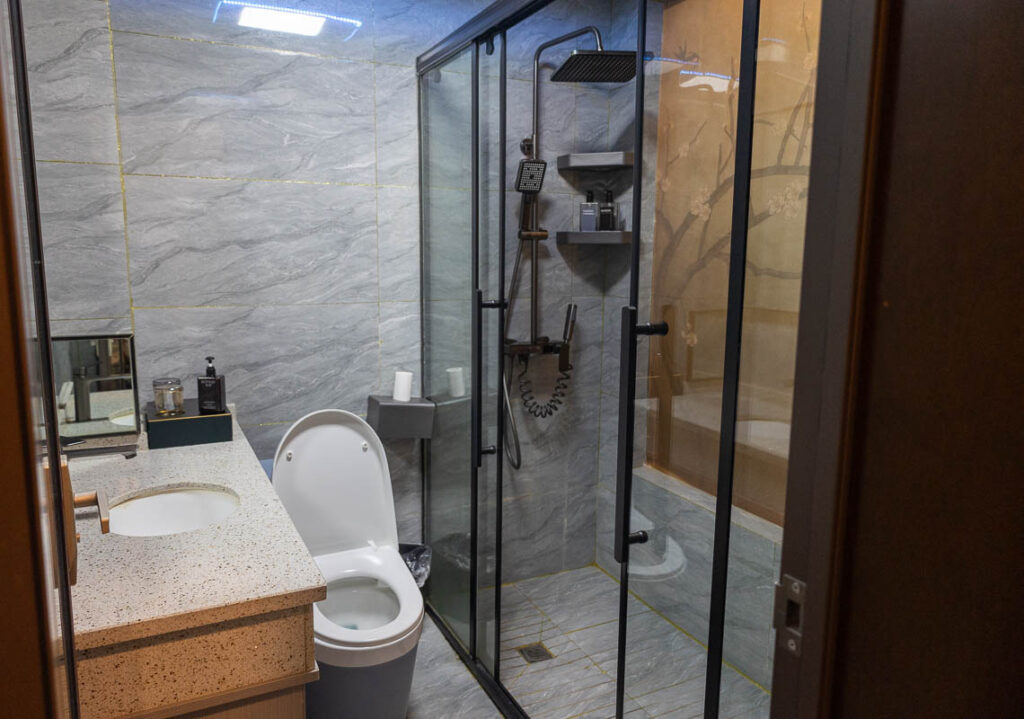
We overnight at Zhaxi Youjia Guesthouse. It’s small and traditional with comfortable ensuite rooms.
So that brings the first exciting week of our China itinerary to an end. Read about our second week in my next post where we finish our journey in Sichuan and cross the border to the western province of Qinghai.
On the second week of our road trip we encounter an assortment of wildlife including Tibetan brown bears, antelopes and pikas. We engrave and offer our own mani stones at Jiana Mani Stone City and visit the UNESCO Dege Print House. And we explore four more monasteries as we continue the path of Tibetan spirituality.
Subscribe to our newsletter to get new posts straight to your inbox.
Pin it for later…
Suzanne Jones is a full-time travel blogger and writer at The Travelbunny which she started in 2011 during her time as a professional travel planner. Suzanne enjoys exploring new destinations, culinary encounters and the outdoors. When not travelling or writing about her adventures you’ll most likely find her, camera in hand, enjoying coastal walks in Sussex.
Suzanne also runs Hello Sussex a website which showcases the best of East & West Sussex. Read more about Suzanne.

